Viser innlegg med etiketten richard conte. Vis alle innlegg

søndag 19. september 2010

Evil Eye/Malocchio


Italy/Spain/Mexico, 1975

Directed by Mario Siciliano

Cast:
Jorge Rivero, Pilar Velazquez, Anthony Steffen, Richard Conte, Maria Pia Giancaro, Eduardo Fajardo, Luis La Torre, Lone Fleming, Daniela Giordano, Luciano Pigozzi, Terele Pavez, Eva Vanicek, Flora Marrone


I’ve previously covered the fluffy porno comedy My Swedish Aunt (1980), directed by former western and war movie specialist Mario Siciliano (1925-1987). Siciliano is not someone who is typically associated with horror movies but he did take two stabs at the genre. One was the genuinely bizarre porno-horror flick Orgasmo esotico (1982) but his first attempt was the stylish and supernaturally themed Evil Eye.

Evil Eye is about Peter Crane (Jorge Rivero), a hunky American millionaire playboy living in Rome. Peter is suffering from bizarre and unsettling nightmares, in which creepy, naked Satanists are compelling him to do bad things. Soon, things take a stranger turn when Peter’s girlfriend Tanya (Maria Pia Giancaro) drags him along to a fashion show, where he meets an attractive French widow named Yvonne (Lone Fleming). On hearing the name Peter Crane, Yvonne is visibly startled, and she reveals to Peter that she has had a strange dream in which her late husband appeared before her and told her she would be murdered by a man named – you guessed it – Peter Crane. At first, Peter suspects the whole thing of being a practical joke orchestrated by his party-loving pal Robert (Luis La Torre) but it quickly transpires that Yvonne is being completely serious. Intrigued and attracted, Peter ends up bringing Yvonne back to his big villa for some hanky panky.


Peter encounters the mysterious Yvonne


However, they don’t get very far before Peter is suddenly struck with an intense headache. A powerful storm sets in and blows the windows open, a sculpture starts to inexplicably move, a painting falls down and shatters a floral vase, and Peter’s eyes turn dark and sinister as he appears to go into some kind of trance. He menacingly approaches Yvonne and starts to strangle her...
Cut to a confused Peter waking up the next morning. Yvonne is gone and everything is back in order. The painting that fell down is back up on the wall, and the no-longer-shattered flower vase is back in its place. It’s as if none of the events from last night ever took place. Was it all just a bad dream?


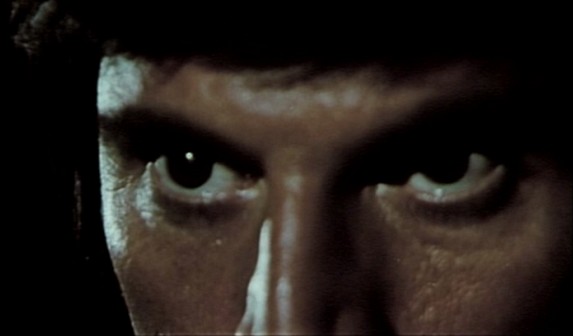

Peter murders Yvonne. Or does he...?


Unable to distinguish nightmares from reality, a concerned Peter contacts psychiatrist Dr. Stone (Richard Conte), an old friend of his father, and confides his concerns to Stone and his sexy colleague Dr. Sarah Turner (Pilar Velazquez). But while Peter is talking to the shrinks, Yvonne’s bloody corpse is fished out of the water. A seasoned police inspector (Anthony Steffen) is assigned the case and starts snooping around.

Peter's shrinks

Yvonne is discovered dead


In the meantime, Peter is being subjected to all kinds of strange tests at Dr. Stone’s clinic, and it doesn’t take long for the sexy Dr. Sarah to lose sight off all professionalism and jump into bed with the hunky Peter. Which might not be such a great idea, because Peter continues to have disturbing nightmares. He also continues to get headaches, attack people and then black out – only to have the people he attacked show up dead shortly afterwards. Is Peter a deranged killer? Or is someone or something taking control over his mind and using him as a killing machine? Or is someone else doing all the killing?


This strange potpourri of giallo and supernatural horror is a real head-scratcher. It’s not the first giallo to employ supernatural elements, of course, as this had already been tried and tested by Emilio G. Miraglia in both The Night Evelyn Came Out of the Grave (1971) and The Red Queen Kills Seven Times (1972), as well as in Armando Crispino’s The Etruscan Kills Again (1972), but in all these examples a naturalistic force is revealed to be at work. As such, Evil Eye is – along with Giuseppe Bennato’s underrated The Killer Reserved Nine Seats (1974) – one of the very few gialli to uphold its supernatural angle throughout the entire running time. And that’s a fresh spin that actually works – at least for a while.

In one of the film’s most intriguing plot twists, it’s implied that all of the victims may at one time have gotten away with murder, and that the people they murdered are now channeling Peter from beyond the grave – taking control of his mind and using him as a vessel to exact vengeance on their murderers. Unfortunately, this plot point is rather clumsily handled and is never fully elaborated on, which is a great shame.

The revenge of the dead?


Sadly, the squandering of the above plot point is just one out of many serious flaws the script is saddled with. Several plot elements are never explained and the narrative is often fairly confusing – resulting in a viewing experience that is at times incoherent and frustrating. Now, there’s nothing wrong with a bit of ambiguity if that is the intention but I have a lingering suspicion that the indecipherable nature of the plot is a result of sloppy and careless screenwriting rather than artistic ambitions. To be fair, neither writer-director Mario Siciliano nor Spanish co-writers Julio Buchs and Federico De Urrutia had any prior experience working within the horror or thriller format, so one should perhaps not judge them too harshly. That’s easier said than done, however, since they foolishly chose to cap the whole thing off with a truly pathetic ending that completely undermines the rest of the film.

But in spite of these serious flaws, Evil Eye also offers a load of redeeming qualities. The film is very well-shot by Vicente Minaya, who in great 1970s tradition employs a lot of stylish shots and odd camera angles, as well as frequent use of Lucio Fulci-style close-ups of the actors’ eyes. Even better is the marvelous Stelvio Cipriani score, which is both catchy and eerie – channeling just the right mood for a supernatural chiller and lending a lot of atmosphere to the proceedings. And Mario Siciliano proves that he has a certain eye for memorable horror movie imagery, with some of the stand-out moments including an opening black mass with a sinister red monk, Peter’s creepy nightmares featuring pale, naked Satanists, and a freakish scene where Eduardo Fajardo vomits up a toad. Plus the kitschy décor, Peter’s funky disco-style wardrobe, the obligatory product placement of J&B bottles, and the impressive roundup of sultry Euro-beauties certainly don’t hurt the proceedings either.

The red monk

Peter's freaky nightmares

Toad-vomiting!!!

Being a co-production between Italy, Spain and Mexico, the film boasts a highly interesting assembly of actors. Mexican muscle hunk Jorge Rivero – whose interesting career includes everything from the Hollywood western Rio Lobo (1970) with John Wayne, to Lucio Fulci’s brainless sword and sorcery flick Conquest (1983) – is a slightly odd choice for the leading role of Peter but he makes a pretty convincing playboy and is quite quick to take his shirt off. Rivero looks really good here and he also does a good job of portraying the character’s bewildered confusion, although it’s hard to say whether or not this is due to great acting skills or because Rivero himself was downright confused by the screenplay.
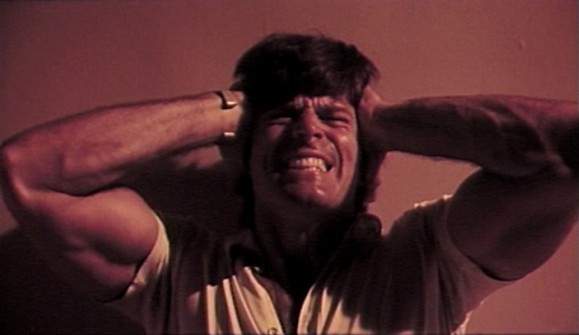
Jorge Rivero freaking out - and looking like he's about to transform into the incredible Hulk


Richard Conte – best known from The Godfather (1972) – acts completely on autopilot as Peter’s psychiatrist. He no doubt signed on only to earn a quick paycheck but at least he doesn’t look as embarrassed here as he did in Cries and Shadows (1975). In the role of the police inspector, stone-faced Anthony Steffen is fairly inexpressive – just like he was in most of the spaghetti westerns he starred in. The great Eduardo Fajardo, however, puts in some real effort and is quite fun as Peter’s polite majordomo.

But the real stars of the show are the delectable female cast members, of which there are many. Spanish spitfire Pilar Velazquez looks absolutely ravishing as Peter’s seductive psychiatrist (she is perhaps too hot be convincing as a shrink but never mind), Maria Pia Giancaro drops her clothes at frequent intervals, and the elegant Lone Fleming (best known as the heroine in the Spanish horror classic Tombs of the Blind Dead) really makes the most of her limited part as the mysterious Yvonne. Only Daniela Giordano (who is almost unrecognizable in an unflattering, short wig) seems wasted in a small role as a woman who insists she has met Peter before. Another interesting actress in the cast is Spanish actress Terele Pavez, who plays the wife of Eduardo Fajardo’s character. Two decades later, Pavez would became a favorite of Spanish cult director Alex de la Iglesia, who cast her in several of his films – including the much celebrated horror film The Day of the Beast (1995).

There's certainly no shortage of babes trying to use their charm on Mr. Rivero


Dubbing fans may want to take note of the fact that dubbing hero Ted Rusoff (whose voice will be familiar to most fans of Italian genre cinema) was in charge of translating and dubbing the film’s dialogue into English, and he also receives an onscreen credit for “additional dialogue”. Rusoff also performs the task of dubbing Jorge Rivero, and, as expected, his real-life wife Carolynn De Fonseca is also onboard – lending her breathy, feminine voice to the sexy Pilar Velazquez (a perfect match). You’ll probably also recognize most of the other dubbing voices (which include Edmund Purdom, Edward Mannix, Christopher Cruise and Silvia Faver), and that may be a good or a bad thing – depending on your point of view. Personally, I've grown very fond of the familiar English dubbing voices that recur in all these great films, and their amazing voice acting is an integral part of this whole 'Euro cult' experience.

Bottom line: There’s some really good stuff and great actors in Evil Eye but, unfortunately, the film isn’t as good as it could have been. Had the script been stronger and more emphasis been put on the plot point about Peter being used as a vessel for revenge by the dead, then it could have been a real winner. As it is, Evil Eye only gets a partial recommendation but it can still be a lot of fun if you're in the right frame of mind.


© 2010 Johan Melle


The cast:


Jorge Rivero as Peter Crane


Pilar Velazquez as Dr. Sarah Turner


Anthony Steffen as The Police Inspector


Richard Conte as Dr. Stone


Maria Pia Giancaro as Tanya


Eduardo Fajardo as Walter, the majordomo


Luis La Torre as Robert Gifford


Lone Fleming as Yvonne Chevrel


Daniela Giordano as Elizabeth Stevens


Luciano Pigozzi as Derek Stevens


Terele Pavez as Walter's wife


??? as Martha, the inspector's wife


Eva Vanicek as Robert's girlfriend

mandag 14. desember 2009

Cries and Shadows/Un urlo nelle tenebre


Italy, 1975

Directed by Franco Lo Cascio

Cast:
Jean Claude Vernè, Patrizia Gori, Mimma Monticelli, Françoise Prévost, Richard Conte, Sonia Viviani, Filippo Perego, Franco Garofalo, Elena Svevo, Giuseppe Tallarico, Giangiacomo Elia


Not surprisingly, the enormous worldwide success of William Friedkin’s landmark horror film The Exorcist (1973) led to a slew of rip-offs that tried to cash in on Friedkin’s film. Italian producers, in particular, churned out several knock-offs that include The Antichrist, Beyond the Door and The Eerie Midnight Horror Show (all 1974). But the Italians also gave us another Exorcist clone named Cries and Shadows, which continues to remain far more obscure than the other Italian exorcist films. The English language title seems to play off on Ingmar Bergman’s Cries and Whispers (1972) but don’t let that worry you. The reason for this film’s obscurity isn't because it's too artsy, but rather because it’s a super-cheap rip-off of the most blatant sort imaginable. Well, they do say that imitation is the sincerest form of flattery but somehow I doubt that William Friedkin was particularly flattered by this film, which not only shamelessly rips off his film but also adds a large chunk of filth and sleaze to the proceedings. But that’s not to say that it doesn’t have its charms. Far from it actually.

The plot deals with a goofy-looking teenage boy named Peter (Jean Claude Vernè), who has a colossal mullet.


Our boy Peter


One day, Peter is going for a walk in the woods with his friends when he suddenly spots a buff naked redhaired woman by a waterfall. Stunned by the sight, Peter quickly whips out his camera and snaps some pictures of the naked lady. When his friends catch up with him, Peter eagerly tells them about his lucky sighting but they all laugh him off and dismiss his story as fantasy.


The lady by the waterfalls


Later, Peter gets the photos from the waterfall developed and is puzzled when the naked woman isn’t visible in any of them. He decides to go back to the waterfall – presumably hoping that the woman will still be there, which of course she isn’t. Peter does, however, find a strange-looking amulet in the water. Even though the amulet is depicting an inverted cross, Peter proclaims it as "my special lucky charm" and hangs it around his neck.


Peter's "special lucky charm"


It turns out that using the amulet as a lucky charm is a pretty bad idea, though, as it doesn’t take long before Peter’s behavior starts to get strange and erratic. This is demonstrated to us in a hilarious scene depicting the 18th birthday party of Peter’s annoying girlfriend Sherry (Sonia Viviani), where Peter pops open a champagne bottle and then proceeds to squirt the champagne over Sherry. This deeply shocks all of the guests – especially Sherry, who reacts by screaming hysterically and running away from the party.


Champagne shocker


Anyway, things really escalate one night when Sherry goes to a disco with some of her friends while Peter sits at home sulking in his room. None too pleased with his newfound "good luck charm", he tosses the amulet on the floor in anger. But no sooner has he thrown away the amulet before the naked, redhaired woman from the waterfall appears on his bed – only now she has a dress on. The sexy lady puts on a real temptress routine by licking her lips seductively and pulling her dress up.


The redhaired tease


What follows is without doubt the coolest moment in the film, as Peter reacts by jumping her and slashing her throat with a knife (as you do), and at the very same time, Sherry’s throat is inexplicably slashed open while she’s dancing in the disco!!! She slumps bloodied and dead to the floor while the rest of the disco patrons look on in horror.


Sherry really turns some heads on the dance floor


From hereon, Peter starts to really act weird. It seems that the sexy redhead is really some sort of demon and Peter gets possessed by her. But he’s not just possessed – every now and then he even morphs into the naked lady demon, and then proceeds to attack and sexually assault his own mother (Françoise Prévost)! With things spiraling out of control, Peter’s sister Elena (Patrizia Gori), a missionary nun living in Africa, returns home to help her poor brother. Doctors diagnose Peter’s problems as "hysteria" and recommend putting him in an asylum but Sister Elena, of course, has a different idea. According to her, Peter is possessed and a good old-fashioned exorcism is what’s needed to fix the problem...


Although direction of the film is credited to Angelo Pannacciò, the man behind the wonderful Sex of the Witch (1973), the real director was actually Franco Lo Cascio, who had served as an assistant director on a number of Fernando Di Leo films and who in the 1980s would end up as a prolific director of hardcore porn. As expected, Lo Cascio’s foray into... erm... "serious" filmmaking doesn’t exactly amount to a particularly good film in the traditional sense of the term. There’s not much originality on display here, with the climatic exorcism ripping off The Exorcist down to the smallest detail. Throughout the film we are also served the expected obscenity-spouting, vomiting and flying furniture.


Flying furniture, hysterical nuns and a cursing mullet teen make for a fun Euro-schlock


Lo Cascio’s additions to the familiar storyline come mostly in the form of added sleaze and nudity; throwing in a black sabbath that ends in a big orgy and plenty of action involving the naked lady demon. The most over-the-top stuff are of course the scenes where Peter transforms into the female demon and sexually assaults his mother and sister – thereby managing to give us incest, lesbianism and nunsploitation (in the case of the sister) all at the same time. It’s so mind-boggingly tasteless and filthy that only the Italians could have come up with it, and I have to admit that it really is quite delightful to just sit back and watch something that is so unpolitically correct. The attack on the nun-sister is particularly off the wall, with the demon telling the poor nun that: “You’re a bitch in heat! Your genitalia is mine!”


Fun at the sabbath


Nuns need luvin' too


While all the sleazy moments are highly enjoyable, the film actually has a few genuinely well-made sequences too, with Sherry’s gory demise on the disco floor being the most memorable. But a hallucination scene where Peter follows the demon through a seemingly abandoned village is quite eerie, too. In fact, all the locations used in the film are effective and, together with a nice musical score, they lend some atmosphere to the proceedings. Trivia buffs may take note of the fact that the location where Peter first spots the naked demon lady is the famous Monte Gelato waterfalls, which has been featured in countless Italian films, including They Call Me Trinity (1970), Torso (1973), The Inglorious Bastards (1977), Ator the Fighting Eagle (1982) and many others.


Peter at the Monte Gelato waterfalls


Also worth mentioning is the weird scene where Sister Elena refuses to let Peter’s doctor admit him to an asylum because she herself has had some horrifying experiences in an asylum. We’re then shown some bizarre, grainy clips of people having a miserable time in an asylum. The whole thing feels completely out of place but it certainly manages to grab one’s attention.


Weird asylum scenes


But while the above sequences work well, the rest of the film contains a lot of clumsy passages that frequently lapse into unintentional hilarity. The scene where Peter squirts champagne on Sherry at her birthday party is the most obvious example. I realize that the filmmakers wanted some kind of social setting to demonstrate that Peter’s behavior is starting to become creepy. In The Exorcist, we got a scene where the possessed girl pees on the carpet in front of her mother’s dinner guests, which really does give you the feeling that something is not quite right with her. But, needless to say, squirting some champagne on your girlfriend isn’t quite in the same league! It just seems so harmless, and this – coupled with Sherry’s overly hysterical reaction – makes the scene very absurd. It’s hard to not laugh out loud at the whole thing.

The film’s narrative, too, is constructed in a rather laughable way. It actually begins with a possessed Peter lying tied to his bed, and then the back story of how he became possessed is told in flashbacks as Sister Elena describes the events to a priest. None of this makes much sense considering the fact that Elena wasn’t actually present to witness any of the events she is describing. The scene where she talks about "that terrible day" when Sherry was killed at the disco doesn’t make any sense at all since there’s no possible way she could know that Sherry’s death was brought on by Peter’s slashing of the female demon’s throat.

Oh, and let’s not forget the acting! The film’s top-billed star is Richard Conte, an American actor of Italian heritage who had a long and successful Hollywood career. After appearing in Francis Ford Coppola’s The Godfather (1972), Conte spent the remainder of his career in Italian films – mainly in crime or cop flicks – before dying of a heart attack in 1975. Conte’s performance here as the exorcist was actually his second-to-last film role and he died a few months before the film hit theatres. In spite of his top-billing, Conte’s role is rather brief and he doesn’t get to do much expect hold up a crucifix while quoting some bible passages – all the while looking suitably embarrassed. It’s quite surprising to see Conte reduced to appearing in such low-grade trash just three years after The Godfather, and definitely a sad end to the career of such a solid actor.


Richard Conte puts an embarrassing end to his long acting career


Also wasted is the attractive French actress Françoise Prévost as Peter’s mother. Prévost is an accomplished and versatile performer who switched between working in more serious films and in various genre efforts like The Murder Clinic (1966) and The Sinful Nuns of St. Valentine (1974), but she gets very little to do here except in the scenes where the female demon attacks her and rips open her nightgown. Hardly a career highlight for her.

Of course, the real "star" of the film is Jean Claude Vernè, the (presumably French) actor who plays Peter. He only appeared in a handful of films and while he doesn’t seem to grasp the concept of acting at all, his grossly exaggerated facial expressions and amazing hairdo makes him a lot of fun to watch as he switches between freaking out, getting naked, shouting obscenities or squirting champagne.

The only performance that can actually be said to be any good is that given by the director’s wife at the time, the lovely and underappreciated Patrizia Gori as Peter’s sister. Gori has a pretty expressive face and is very good at instilling sympathy for the characters she plays, as evidenced by her strong performance in Joe D’Amato’s excellent Emanuelle’s Revenge (1975). I also like how she looks very different in nearly all of her films – having started out as a platinum blonde, then switching to brunette, and for her role in this film she actually shaved herself bald.


Patrizia Gori delivers the goods as always


While the rest of the actors don’t exactly shine, there are some welcome familiar faces in place here, including Bruno Mattei favorite Franco Garofalo from Hell of the Living Dead (1980) and The Other Hell (1981) as the guy conducting the black sabbath at the start of the film, a very young Sonia Viviani as Peter’s idiot girlfriend, and even dear, old primitive-looking Salvatore Baccaro of The Beast in Heat (1977) infamy puts in an uncredited appearance as a briefly seen participant at the black sabbath. Oh, and Mimma Monticelli may not be a very well-known actress but believe me when I say that her appearance as the naked demon will keep your eyes constantly glued to the screen.

In short, Cries and Shadows isn’t exactly a good film but its daftness nevertheless adds greatly to the overall package, and it succeeds in creating a near perfect balance between unintentionally funny rubbish, jaw-dropping tastelessness and occasional moments of surprising effectiveness. If you’re in search of a trashy Italian flick to keep you entertained then look no further!


© 2009 Johan Melle


The cast:


Jean Claude Vernè as Peter


Patrizia Gori as Sister Elena


Mimma Monticelli as The Demon


Françoise Prévost as Barbara, Peter's mother


Richard Conte as The Exorcist


Sonia Viviani as Sherry


Filippo Perego as The Priest


Franco Garofalo as The Black Sabbath Leader


Elena Svevo (a.k.a. Elisabeth Tulin) as Anna


Giuseppe Tallarico as The Doctor


Giangiacomo Elia (a.k.a. John Ely) as The Police Inspector


Salvatore Baccaro as A Black Sabbath Participant