
Italy, 1971
Directed by Osvaldo Civirani
Cast:
Carroll Baker, George Hilton, Stephen Boyd, Lucretia Love, Daniele Vargas, Franco Ressel, Luciano Pigozzi, Ivano Staccioli, Roberto Messina, Maria Ricotti
Directed by Osvaldo Civirani
Cast:
Carroll Baker, George Hilton, Stephen Boyd, Lucretia Love, Daniele Vargas, Franco Ressel, Luciano Pigozzi, Ivano Staccioli, Roberto Messina, Maria Ricotti
It’s time to kick off the new year with a new review! The first film I’ll be reviewing this year is The Devil with Seven Faces, directed by Osvaldo Civirani, a fairly obscure filmmaker who is best known for a series of westerns, but he was really a jack of all trades and through the course of his 13-year career he cranked out Eurospy adventures, peplums, erotica, sexy mondo movies, and comedies with Franco and Ciccio. The Devil with Seven Faces was Civirani’s only stab at the then wildly popular giallo sub-genre, although it must be said to be somewhat of a borderline entry.
Julie Harrison (Carroll Baker) is an American living in Amsterdam, where she works as a translator. Unfortunately, things aren’t going too well for her at the moment as she has the distinct impression that someone is spying on her. Julie’s worries are amplified when her identical twin sister Mary phones from London and says she’s in danger before the line is abruptly cut off.

Julie receives an alarming phone call from her twin sister - naturally through a yellow telephone
Julie seeks out her lawyer friend Dave Barton (Stephen Boyd) and confides her worries to him. But no sooner has Julie left Dave’s office than a pair of sleazy thugs are jumping her and trying to pull her into a car. Fortunately, Dave and his hunky, race car driving friend Tony Shane (George Hilton – dubbed by Christopher Cruise) come rushing to Julie’s aide and are able to fend off her would-be kidnappers who hurriedly flee the scene. Tony nonchalantly introduces himself to Julie by telling her that “Saving beautiful women is my hobby”, and apparently that’s all it takes to woo her. The two begin dating and leave it mostly up to poor Dave to try and figure out who Julie’s tormentors are and what’s happened to her twin sister!


Tony comes to Julie's rescue

Julie and her two beaus try to figure out what to do...

...but Tony appears somewhat more keen on romance
After a night on the town, Julie and Tony head back to her place, but the thugs who tried to kidnap her earlier are waiting for them. Tony gets a gun to his head and is forced to watch as the leader, a low-life named Hank (Ivano Staccioli), pins Julie to the sofa, rips her blouse open and puts a knife to her throat. It turns out they’ve mistaken Julie for her twin sister Mary, who has apparently stolen a one-million dollar diamond in London and then double-crossed her accomplices and made off with the diamond herself...


Julie and Tony are menaced by the baddies
In spite of its classic giallo title, The Devil with Seven Faces just barely qualifies as a giallo at all. It’s really more of crime-thriller with a couple of double crosses and surprise twists thrown in here and there, but unfortunately, it fails to provide much in the way of excitement regardless of what genre it belongs to. The main drawback is a tired and uninspired script (co-written by Tito Carpi and director Civirani), which is surprisingly uneventful and short on thrills – with an absurd amount of screen time devoted to showing the characters puff cigarettes or talk on the phone. Not helping matters are the hopelessly predictable twists that will come as a surprise to no one (the ‘big reveal’ about the twin sisters is telegraphed way in advance), and the script’s weaknesses are amplified by Civirani’s dull and pedestrian direction, which stops the feeble attempts at building suspense dead in their tracks.
The film on the whole is awfully tame, with the tone being set already in the ridiculous opening sequence in which Julie is stalked by a mysterious stranger who catches up with her and, instead of attacking her, merely whips out a camera and start snapping pictures of her – causing her to faint. It’s a terribly lackluster way to kick off the film and it fails to set up Julie’s stalkers as any serious threat to her well-being. At various later points in the film they make a half-hearted attempt to kidnap her, threaten her with a knife or force her head into bathtub full of water but with Civirani’s ham-fisted direction there’s never any real excitement and one never fears that Julie will come to any lasting harm.
Compensating for the aforementioned dreariness is a pretty awesome cast, although none of the actors are utilized all that well. Carroll Baker’s leading turn in Romolo Guerrieri’s hugely successful The Sweet Body of Deborah (1968) led to her starring in a string of gialli in which she played sexy damsels in distress who may or may not be as innocent as they first appear. By 1971, however, Baker had clearly grown rather tired of such roles, which her largely disengaged performance in The Devil with Seven Faces is ample proof of. She’s mostly phoning it in here and couldn’t even be persuaded to provide some nudity this time around. George Hilton – who had made his giallo debut alongside Baker in The Sweet Body of Deborah – was even more of giallo superstar at this point, but unlike Baker, he doesn’t seem to have tired of such films. The script admittedly gives him nothing to do but to rehash his old act as the shifty-faced Latin lothario (with plenty of close-ups of him doing shady expressions to make us ponder whether he’s a goodie or a baddie), but at least he looks great in his chic designer clothes.

George Hilton puts on a sinister face for the camera

This is a risqué as Carroll Baker was willing to get this time
The one that comes off the best is Stephen Boyd as Baker’s lawyer friend. Irish-born Boyd is best known for his excellent performance as Messala in the legendary Hollywood epic Ben-Hur (1959), but his career started dwindling in the late 1960s – propelling him into a period of doing European B-movies that would last until his premature death of a heart attack in 1977. He’s clearly not taking himself too seriously here, but his relaxed demeanor and natural charm serve him well and he’s a great asset to the film.


Stephen Boyd's suave charms and relaxed attitude is one of the film's saving graces
The cast also includes the lovely Lucretia Love, who is pretty wasted as Baker’s secretary, and the always welcome Franco Ressel as a police inspector, while beloved character actors Luciano Pigozzi, Daniele Vargas and Ivano Staccioli play various low-lives out to get their hands on the million dollar diamond. They don’t get a lot to do, but they’ve got the perfect faces for their parts and their sheer presence adds to the enjoyment.

The great Luciano Pigozzi can always be relied on to provide some good fun
Thankfully, the film offers a few other redeeming features as well. A rare stand-out sequence occurs when Baker hears strange noises and decides to explore a dark, cob-webbed attic – with nothing but a cigarette lighter to light the way for her – and happens upon a corpse. It’s an atmospheric and well-crafted sequence, but it undeniably feels as though it has been shoehorned into the film for no good reason other than to have a dead body turn up. Additionally, the climax at an old, deserted windmill is also reasonably effective and offers a couple of mild thrills.


One of the film's more atmospheric moments


The climax where a scantily clad Baker is menaced in an abandoned windmill is good fun
Another strong asset is the loungy, delightful score by the always excellent Stelvio Cipriani, featuring wordless vocals by the great Nora Orlandi. It's also a pretty nicely shot film and the Amsterdam locations are great, though somewhat underused.
If that’s not enough to keep your interest up, there’s always some unintentional fun to be had in the form of silly dubbed dialogue, a ridiculous-looking car chase with speeded up footage, and some hilariously unsubtle product placement (all of the characters are constantly smoking and there are more close-ups of cigarette packs than I was able to keep track of). But the biggest WTF moment by far is when a knife-wielding guy in a gorilla mask enters Carroll Baker’s office and scares her half to death before revealing himself to be her pranking Asian work colleague who grinningly tells her “I gweat authowity on howwow stowies!” It’s like a little precursor to the infamous jump scare sequence in J.P. Simon's Pieces (1982) in which Lynda Day George is inexplicably attacked by an Asian guy who then blames his violent outburst on some bad chop suey.


The pictures speak for themselves, really!


Hardly a scene goes by in this film without the actors puffing away on some Peer Export cigarettes. I wouldn't be surprised if that's where a large chunk of the film's budget came from
And, as expected, the (then) trendy design and fashion tastes on display are another source of constant amusement. Apparently, nothing was considered too much when it came to fashion back in the early 1970s, and “less is more” was a clearly a term unheard of. Gialli are the ultimate showcase for the period’s stunning lack of restraint, and The Devil with Seven Faces is no exception as it is ripe with amazing mod fashions, oversized table lamps, hideous abstract art, and a seemingly endless supply of wigs. Carroll Baker and Lucretia Love keep changing in and out of wigs for no good reason at all – some of which are sexy, while others are hilariously unfitting. The pièce de résistance is surely the blue, braided one worn by Baker while she’s sunbathing on a beach together with a suited Stephen Boyd. Big kudos to Boyd for keeping a straight face throughout that insanely absurd scene!

Julie's office is a real sight to marvel at. Just look at that floral painting and the yellow table lamp!

No comment necessary!!

There's definitely no shortage of horrible art and funky wigs on display
I can't possibly recommend anyone to seek out a film as lackluster as The Devil with Seven Faces, but for all its flaws, it also does have its weird charms, so I guess you'd might as well give it a spin on a rainy day. But keep your expectations low.
© 2015 Johan Melle
The cast:

Carroll Baker as Julie Harrison/Mary Harrison

George Hilton as Tony Shane

Stephen Boyd as Dave Barton

Lucretia Love as Margaret

Daniele Vargas as James Marlowe

Franco Ressel as Inspector Rinkel

Luciano Pigozzi as Steve Hunter

Ivano Staccioli as Hank

Robert Messina as A henchman
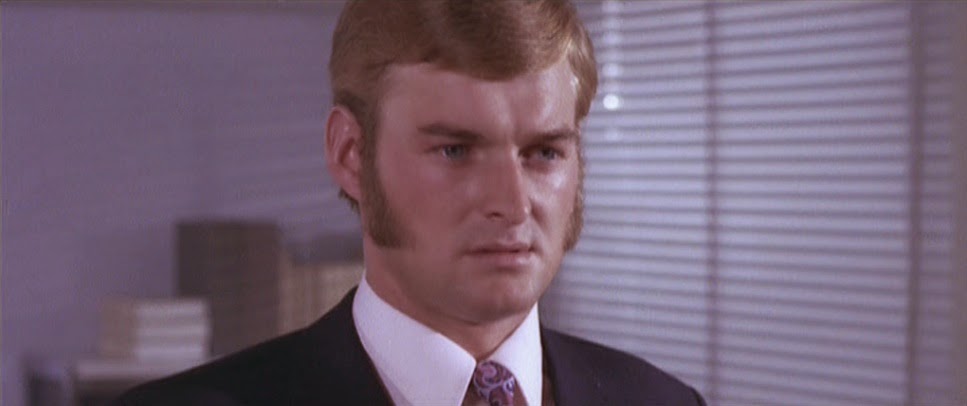
??? as Sgt. Van Doren

??? as Dave's secretary

??? as A henchman

??? as Mrs. Horst


