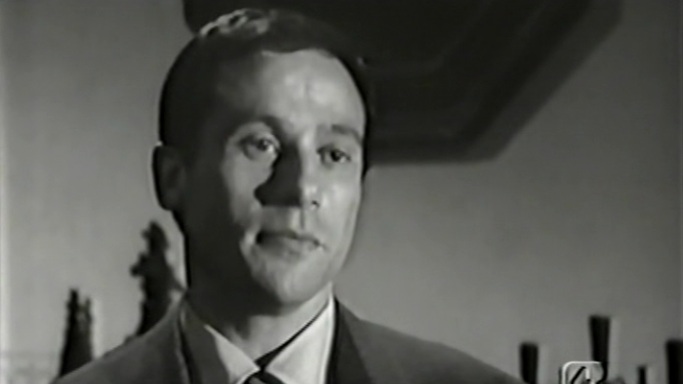
Italy/France, 1966
Directed by Lionello De Felice
Cast:
William Berger, Françoise Prevost, Barbara Wilson, Mary Young, Harriet White, Germano Longo, Massimo Righi, Delfi Mauro, Anna Maria Polani, Philippe Hersent, Rossella Bergamonti, Rock Scandurra
Directed by Lionello De Felice
Cast:
William Berger, Françoise Prevost, Barbara Wilson, Mary Young, Harriet White, Germano Longo, Massimo Righi, Delfi Mauro, Anna Maria Polani, Philippe Hersent, Rossella Bergamonti, Rock Scandurra
Here is yet another example of the early gialli from the 1960s – made in the years before Dario Argento and his ‘animal trilogy’ would come to dictate the success formula of the genre. Released in Italy as La lama nel corpo – i.e. The Knife in the Body – and supposedly based on a novel with the same title by a certain Robert Williams, The Murder Clinic was more successful than many of the other early gialli and received a fair amount of worldwide distribution. In the US it was cut down, renamed Revenge of the Living Dead, and shown as part of a triple horror feature named “Orgy of the Living Dead” – together with Mario Bava’s Kill, Baby... Kill! (as Curse of the Living Dead) and Amando De Ossorio’s Malenka, the Niece of the Vampire (as Fangs of the Living Dead). Moviegoers who showed up expecting to catch a zombie film must have been disappointed as The Murder Clinic features no living dead action of any sort. In fact, it is more of a hybrid between classic gothic horror and giallo mystery.
Set in 1870, the titular murder clinic is actually a “rest home” for the mentally ill, situated in the forest-filled countryside. It’s a huge gothic villa – the same that was used in The Third Eye (1966), The Nights of Terror (1980) and Patrick Still Lives (1980) – and is run by the handsome Dr. Robert Vance (William Berger), who also resides there with his wife and the medical staff. Dr. Vance was once a promising physician who seemed destined for great things but it appears that some kind of scandal in his past put an abrupt end to his career, and hence his reason for running this obscure asylum, which is occupied only by a few patients.
 The mysterious Dr. Vance
 The murder clinic!
One of the patients is Janey (Anna Maria Polani), a young woman who is mute – presumably due to some type of trauma. As we first meet Janey she’s in her room with a newly arrived nurse named Mary (Barbara Wilson), who reads aloud to her from a book about the execution of Mary Stuart. I’m not so sure that this is the most appropriate type of literature for a girl who is clearly quite traumatized, but then again I’m not an asylum nurse, so what do I know? Anyway, their reading session is interrupted by the arrival of Dr. Vance’s stern assistant and housekeeper Sheena (Harriet White), who informs them it’s 9 in the evening and all patients must go to sleep.
 Janey
Janey
 Poor Janey is read a not very cheerful bedtime story
But later that night, Janey is awakened from her sleep when a mysterious figure wearing a black cloak and black leather gloves breaks into her room and attacks her with a straight razor. The poor mute girl is unable to call for help but manages to escape out the window and runs for her life. But when she reaches the garden, Janey – in what must surely be some kind of cinematic first – suddenly interrupts her flight in order to drink from a fountain! All that running must have made her thirsty, I guess, and while she’s busy drinking, the killer sneaks up on her and slashes her to death.
 The Blade of the Ripper

 Janey chooses the worst possible moment to quench her thirst...
Next morning, the kind nurse Mary goes to check up on Janey and is surprised that she is nowhere to be found. She is informed by Dr. Vance that Janey left at the crack of dawn as her relatives showed up to take her back home. Dr. Vance and Sheena are both very evasive on the subject, however, and Mary is clearly a bit skeptical. Her concerns are not lessened by the fact that a lot of strange noises are heard coming from the third floor. Mary wonders what’s going on up there but Dr. Vance expressly forbids her and the rest of the staff from going upstairs.
 Sheena and Dr. Vance’s fishy behavior doesn’t inspire much confidence
 Mary wonders about the strange noises coming from upstairs
In the meantime we are introduced to a sexy and elegant woman named Gisèle de Brantôme (Françoise Prevost), who is travelling by coach together with a man (Philippe Hersent) who is assigned with escorting her to some place where she clearly doesn’t want to go. It seems that Gisèle has committed some rather wicked acts in order for her to be shipped away like this but the details of her actions are hazy to say the least. But fortunately for Gisèle, the coach gets stuck, and when her escort steps out to fix the problem she seizes the opportunity to club him over the head. This action scares the horses, who run off with the coach – trampling over the poor man and killing him in the process. Stranded, Gisèle wanders around in the forest until she happens upon a grotto. There, she witnesses Dr. Vance digging a hole in the ground to bury the corpse of poor Janey.

 Gisèle discovers a dark secret
Gisèle quickly runs away but ends up falling asleep in the forest. She is eventually found by Dr. Vance, who brings her back to the clinic and kindly offers to let her stay as his guest. Gisèle happily accepts the invitation and keeps quiet about what she has witnessed in the forest. However, she quickly starts snooping around to try and find out more about what kind of secrets Dr. Vance is keeping, and it soon transpires that all of the strange noises in the villa are coming from a horribly disfigured woman that Dr. Vance keeps hidden away in the attic. It even appears as though the good doctor might be responsible for the woman’s disfigurement...
 Gisèle snoops around where she ought not to...
 The “monster” in the attic
Soon, more women are slashed to death by the razor wielding figure in black but Dr. Vance is adamant that the police must not be involved. But is he really the murderer or is he merely protecting the deformed woman in the attic? Or perhaps the killer is someone else entirely? There is certainly no shortage of suspicious characters. In addition to the stern and fiercely loyal Sheena there’s also Lizabeth (Mary Young), Vance’s jealous and unhappy wife; Fred (Massimo Righi), a schizophrenic patient who seems very nice until he explodes in sudden fits of violence; and Ivan (Germano Longo), the brutish orderly who sleeps around with the nurses and always carries a knife or a razor around.


 Which one is the murderer?
The opening titles and various publicity materials credit the direction to the pseudonymous “Michael Hamilton”, and according to pretty much every official source, the man behind this alias is Elio Scardamaglia, the film’s producer. However, Scardamaglia never directed anything else either before or after The Murder Clinic, and it seems rather odd that he would entrust the directorial duties to himself instead of someone with more experience. Well, as it turns out, he didn’t. In a Video Watchdog interview from 1997, the film’s screenwriter, Ernesto Gastaldi, clearly states that Scardamaglia produced the film but did not direct it. According to Gastaldi, the actual director of The Murder Clinic is Lionello De Felice, who made a few films in the 1940s and 50s but who remains pretty much forgotten about today. This is supported by various posters and promotional ads bearing a producer’s credit for Scardamaglia and a director’s credit for “Michael Hamilton”.
 French promotional art for the film. Note the credit for Elio Scardamaglia as producer and for “Michael Hamilton” as director
Many of the early gialli, such as Death on the Fourposter (1964), A Game of Crime (1964), Libido (1965) and A... come assassino (1966) were – in spite of their gothic castle settings and black & white photography – ultimately modern stories far removed from the traditions of classic Italian horror cinema. The Murder Clinic, however, fully embraces its gothic trappings and even opts for a period setting. In fact, Ernesto Gastaldi and Luciano Martino’s script throws in just about every hallmark of gothic horror – from ladies in nightgowns exploring dark hallways to a “monster” hidden away in the attic – and this concoction of old clichés isn’t particularly original. Hence the film’s novelty value is due to the way it mixes a classic gothic horror story with a twistful giallo mystery, and thankfully, the script’s mystery angle works quite well because Gastaldi and Martino have come up with a host of likely suspects – any one of whom could well be the murderer.
Another important element is the styling of the killer as a dark-clad, razor wielding maniac with black leather gloves, which is very much in keeping with how the killers would be styled in many gialli released in the wake of Dario Argento’s films. But still, in terms of look and feel The Murder Clinic clearly favors a gothic atmosphere, and the razor murders feel almost a little tacked on, seeing as how they are brief and not terribly graphic. This might be connected to director Lionello De Felice’s background, for although he had contributed to the screenplays of a fair number of peplum adventures, De Felice’s directorial credits were mostly limited to a couple of musicals and comedies made in the 1940s and 50s. As such, he was probably a bit unsure about how to handle such violent scenes and it shows. Fortunately, De Felice is more successful in handling the old-school horror elements, and boasts a couple of good, atmospheric chills and great screaming scenes.


 Scream and Scream Again
Visually, The Murder Clinic is densely atmospheric throughout its entire running time, putting its locations to good use and featuring some nice cinematography with effective use of lighting and dark corridors. And let’s not forget those terrifically stylish and fetishistic images of the black-gloved killer roaming the dark corridors while clutching a straight razor. The score by Francesco De Masi is another strong asset and features a chillingly effective main theme. Here, the film shows a more modern influence as the score is far removed from the often old-fashioned compositions heard in the earlier Italian gothic horror films.

 Lots of stylish imagery on display
 I love this great shot, which foreshadows an iconic scene in Dario Argento’s The Bird with the Crystal Plumage
The Murder Clinic moves at a generally tight pace and is consistently atmospheric and enjoyable. Its only really serious flaw is that it occasionally focuses too much on the sentimental details of the plot – including a nauseatingly syrupy flashback montage portraying the idyllic past of the troubled Dr. Vance. Indeed, the character of Dr. Vance is not handled too well on the whole. His behavior is so overly suspicious – with him burying a corpse and making all kinds of strange excuses, working on strange experiments, and hiding the woman whose disfigurement he may have had a hand in. His suspicious behavior is taken to such extremes that it will be apparent to just about anyone that he isn’t the actual culprit. In fact, Dr. Vance is so much of a red herring that he never really develops as a real character, and that’s a shame considering that he is played by the always reliable William Berger. But even in spite of the problems connected to his character, Berger manages to deliver a good performance and he lends a sense of authority to the proceedings.
But the most memorable performance by far is given by the excellent French actress Françoise Prevost, who is absolutely terrific as the opportunistic and delightfully bitchy Gisèle. While not a radiant beauty, Prevost possesses a very captivating energy and sexiness that immediately draws you in. She looks as if she really enjoyed herself here, and that’s no wonder when you consider how meaty the role is. Her most priceless moment is a scene where she mercilessly blackmails a greatly annoyed Berger and then two seconds later she starts to press herself up against him while she seductively purrs that it “must be very exciting to make love with a murderer”.
 Absolutely love this shot of Françoise Prevost. There’s something incredibly sexy about it
 Françoise blackmails and flirts at the same time in one of the film’s most delicious moments
Harriet White – Italian horror cinema’s sinister housekeeper par excellence – is slightly underused in the role Dr. Vance’s stern assistant. She could have been given more to do but it’s a nice role and she positively shines whenever she’s on screen. Her hostile exchanges with the bitchy Prevost are particularly delightful. Less fortunate is Massimo Righi, who portrays the madness of his schizophrenic character with such gross exaggeration that he comes across as somewhat awkward.
 Harriet White and Françoise Prevost have a go at each other
 Massimo Righi takes it a bit too far
The film’s English language version prepared by Lewis E. Ciannelli is generally quite good and benefits greatly from the fact that William Berger and Harriet White both dub themselves. The dubbing of the remaining cast is good, with top honors going to Carolynn De Fonseca, whose breathy, feminine voice is an absolute perfect match for Françoise Prevost in the role of the seductive and wicked Gisèle. One curious detail worth noting, however, is the fact that Gisèle’s male travelling companion is portrayed merely as her escort in the English version, whereas in the German and French language versions, the dialogue identifies him as Gisèle’s husband. Since I haven’t seen the film in Italian, I cannot comment on how the character is presented in the Italian dub but I find this to be a rather interesting little detail nonetheless.
 The small role of Gisèle’s travelling companion (played by French actor Philippe Hersent) takes on a different role depending on which language version you are watching
The Murder Clinic may not be perfect but it’s a very interesting hybrid of gothic horror and giallo that benefits from a wonderful atmosphere, strong visuals and some terrific performances by Françoise Prevost and Harriet White. Well worth a look.
And here to round off the review are a some more rare promotional pieces from my collection:
 Cool Italian newspaper advertisement
 Gorgeous artwork from a rare French publicity brouchure I snagged on eBay some years back
 More French artwork
 Nice-looking German movie program containing a detailed plot summary of the film
 The backside of the German film program
 Lovely black & white still from the French publicity brochure, featuring a scene with the beautiful Barbara Wilson (surely a pseudonym, but for whom?) and with Harriet White, William Berger and Germano Longo in the background
© 2013 Johan Melle
The cast:
 William Berger as Dr. Robert Vance
 Françoise Prevost as Gisèle de Brantôme
 Barbara Wilson as Mary
 Mary Young as Lizabeth Vance
 Harriet White as Sheena
 Germano Longo as Ivan
 Massimo Righi as Fred
 Delfi Mauro as Laura
 Anna Maria Polani as Janey
 Philippe Hersent as Gisèle’s escort [husband in some versions]
 Rossella Bergamonti as Kitty
 Rock Scandurra as Walter
 ??? as Mrs. Hurley
Set in 1870, the titular murder clinic is actually a “rest home” for the mentally ill, situated in the forest-filled countryside. It’s a huge gothic villa – the same that was used in The Third Eye (1966), The Nights of Terror (1980) and Patrick Still Lives (1980) – and is run by the handsome Dr. Robert Vance (William Berger), who also resides there with his wife and the medical staff. Dr. Vance was once a promising physician who seemed destined for great things but it appears that some kind of scandal in his past put an abrupt end to his career, and hence his reason for running this obscure asylum, which is occupied only by a few patients.


One of the patients is Janey (Anna Maria Polani), a young woman who is mute – presumably due to some type of trauma. As we first meet Janey she’s in her room with a newly arrived nurse named Mary (Barbara Wilson), who reads aloud to her from a book about the execution of Mary Stuart. I’m not so sure that this is the most appropriate type of literature for a girl who is clearly quite traumatized, but then again I’m not an asylum nurse, so what do I know? Anyway, their reading session is interrupted by the arrival of Dr. Vance’s stern assistant and housekeeper Sheena (Harriet White), who informs them it’s 9 in the evening and all patients must go to sleep.


But later that night, Janey is awakened from her sleep when a mysterious figure wearing a black cloak and black leather gloves breaks into her room and attacks her with a straight razor. The poor mute girl is unable to call for help but manages to escape out the window and runs for her life. But when she reaches the garden, Janey – in what must surely be some kind of cinematic first – suddenly interrupts her flight in order to drink from a fountain! All that running must have made her thirsty, I guess, and while she’s busy drinking, the killer sneaks up on her and slashes her to death.


Next morning, the kind nurse Mary goes to check up on Janey and is surprised that she is nowhere to be found. She is informed by Dr. Vance that Janey left at the crack of dawn as her relatives showed up to take her back home. Dr. Vance and Sheena are both very evasive on the subject, however, and Mary is clearly a bit skeptical. Her concerns are not lessened by the fact that a lot of strange noises are heard coming from the third floor. Mary wonders what’s going on up there but Dr. Vance expressly forbids her and the rest of the staff from going upstairs.


In the meantime we are introduced to a sexy and elegant woman named Gisèle de Brantôme (Françoise Prevost), who is travelling by coach together with a man (Philippe Hersent) who is assigned with escorting her to some place where she clearly doesn’t want to go. It seems that Gisèle has committed some rather wicked acts in order for her to be shipped away like this but the details of her actions are hazy to say the least. But fortunately for Gisèle, the coach gets stuck, and when her escort steps out to fix the problem she seizes the opportunity to club him over the head. This action scares the horses, who run off with the coach – trampling over the poor man and killing him in the process. Stranded, Gisèle wanders around in the forest until she happens upon a grotto. There, she witnesses Dr. Vance digging a hole in the ground to bury the corpse of poor Janey.


Gisèle quickly runs away but ends up falling asleep in the forest. She is eventually found by Dr. Vance, who brings her back to the clinic and kindly offers to let her stay as his guest. Gisèle happily accepts the invitation and keeps quiet about what she has witnessed in the forest. However, she quickly starts snooping around to try and find out more about what kind of secrets Dr. Vance is keeping, and it soon transpires that all of the strange noises in the villa are coming from a horribly disfigured woman that Dr. Vance keeps hidden away in the attic. It even appears as though the good doctor might be responsible for the woman’s disfigurement...


Soon, more women are slashed to death by the razor wielding figure in black but Dr. Vance is adamant that the police must not be involved. But is he really the murderer or is he merely protecting the deformed woman in the attic? Or perhaps the killer is someone else entirely? There is certainly no shortage of suspicious characters. In addition to the stern and fiercely loyal Sheena there’s also Lizabeth (Mary Young), Vance’s jealous and unhappy wife; Fred (Massimo Righi), a schizophrenic patient who seems very nice until he explodes in sudden fits of violence; and Ivan (Germano Longo), the brutish orderly who sleeps around with the nurses and always carries a knife or a razor around.


The opening titles and various publicity materials credit the direction to the pseudonymous “Michael Hamilton”, and according to pretty much every official source, the man behind this alias is Elio Scardamaglia, the film’s producer. However, Scardamaglia never directed anything else either before or after The Murder Clinic, and it seems rather odd that he would entrust the directorial duties to himself instead of someone with more experience. Well, as it turns out, he didn’t. In a Video Watchdog interview from 1997, the film’s screenwriter, Ernesto Gastaldi, clearly states that Scardamaglia produced the film but did not direct it. According to Gastaldi, the actual director of The Murder Clinic is Lionello De Felice, who made a few films in the 1940s and 50s but who remains pretty much forgotten about today. This is supported by various posters and promotional ads bearing a producer’s credit for Scardamaglia and a director’s credit for “Michael Hamilton”.

Many of the early gialli, such as Death on the Fourposter (1964), A Game of Crime (1964), Libido (1965) and A... come assassino (1966) were – in spite of their gothic castle settings and black & white photography – ultimately modern stories far removed from the traditions of classic Italian horror cinema. The Murder Clinic, however, fully embraces its gothic trappings and even opts for a period setting. In fact, Ernesto Gastaldi and Luciano Martino’s script throws in just about every hallmark of gothic horror – from ladies in nightgowns exploring dark hallways to a “monster” hidden away in the attic – and this concoction of old clichés isn’t particularly original. Hence the film’s novelty value is due to the way it mixes a classic gothic horror story with a twistful giallo mystery, and thankfully, the script’s mystery angle works quite well because Gastaldi and Martino have come up with a host of likely suspects – any one of whom could well be the murderer.
Another important element is the styling of the killer as a dark-clad, razor wielding maniac with black leather gloves, which is very much in keeping with how the killers would be styled in many gialli released in the wake of Dario Argento’s films. But still, in terms of look and feel The Murder Clinic clearly favors a gothic atmosphere, and the razor murders feel almost a little tacked on, seeing as how they are brief and not terribly graphic. This might be connected to director Lionello De Felice’s background, for although he had contributed to the screenplays of a fair number of peplum adventures, De Felice’s directorial credits were mostly limited to a couple of musicals and comedies made in the 1940s and 50s. As such, he was probably a bit unsure about how to handle such violent scenes and it shows. Fortunately, De Felice is more successful in handling the old-school horror elements, and boasts a couple of good, atmospheric chills and great screaming scenes.


Visually, The Murder Clinic is densely atmospheric throughout its entire running time, putting its locations to good use and featuring some nice cinematography with effective use of lighting and dark corridors. And let’s not forget those terrifically stylish and fetishistic images of the black-gloved killer roaming the dark corridors while clutching a straight razor. The score by Francesco De Masi is another strong asset and features a chillingly effective main theme. Here, the film shows a more modern influence as the score is far removed from the often old-fashioned compositions heard in the earlier Italian gothic horror films.


The Murder Clinic moves at a generally tight pace and is consistently atmospheric and enjoyable. Its only really serious flaw is that it occasionally focuses too much on the sentimental details of the plot – including a nauseatingly syrupy flashback montage portraying the idyllic past of the troubled Dr. Vance. Indeed, the character of Dr. Vance is not handled too well on the whole. His behavior is so overly suspicious – with him burying a corpse and making all kinds of strange excuses, working on strange experiments, and hiding the woman whose disfigurement he may have had a hand in. His suspicious behavior is taken to such extremes that it will be apparent to just about anyone that he isn’t the actual culprit. In fact, Dr. Vance is so much of a red herring that he never really develops as a real character, and that’s a shame considering that he is played by the always reliable William Berger. But even in spite of the problems connected to his character, Berger manages to deliver a good performance and he lends a sense of authority to the proceedings.
But the most memorable performance by far is given by the excellent French actress Françoise Prevost, who is absolutely terrific as the opportunistic and delightfully bitchy Gisèle. While not a radiant beauty, Prevost possesses a very captivating energy and sexiness that immediately draws you in. She looks as if she really enjoyed herself here, and that’s no wonder when you consider how meaty the role is. Her most priceless moment is a scene where she mercilessly blackmails a greatly annoyed Berger and then two seconds later she starts to press herself up against him while she seductively purrs that it “must be very exciting to make love with a murderer”.


Harriet White – Italian horror cinema’s sinister housekeeper par excellence – is slightly underused in the role Dr. Vance’s stern assistant. She could have been given more to do but it’s a nice role and she positively shines whenever she’s on screen. Her hostile exchanges with the bitchy Prevost are particularly delightful. Less fortunate is Massimo Righi, who portrays the madness of his schizophrenic character with such gross exaggeration that he comes across as somewhat awkward.


The film’s English language version prepared by Lewis E. Ciannelli is generally quite good and benefits greatly from the fact that William Berger and Harriet White both dub themselves. The dubbing of the remaining cast is good, with top honors going to Carolynn De Fonseca, whose breathy, feminine voice is an absolute perfect match for Françoise Prevost in the role of the seductive and wicked Gisèle. One curious detail worth noting, however, is the fact that Gisèle’s male travelling companion is portrayed merely as her escort in the English version, whereas in the German and French language versions, the dialogue identifies him as Gisèle’s husband. Since I haven’t seen the film in Italian, I cannot comment on how the character is presented in the Italian dub but I find this to be a rather interesting little detail nonetheless.

The Murder Clinic may not be perfect but it’s a very interesting hybrid of gothic horror and giallo that benefits from a wonderful atmosphere, strong visuals and some terrific performances by Françoise Prevost and Harriet White. Well worth a look.
And here to round off the review are a some more rare promotional pieces from my collection:


© 2013 Johan Melle
The cast: