Viser innlegg med etiketten lucretia love. Vis alle innlegg

onsdag 7. januar 2015

The Devil with Seven Faces/Il diavolo a sette facce


Italy, 1971

Directed by Osvaldo Civirani

Cast:
Carroll Baker, George Hilton, Stephen Boyd, Lucretia Love, Daniele Vargas, Franco Ressel, Luciano Pigozzi, Ivano Staccioli, Roberto Messina, Maria Ricotti


It’s time to kick off the new year with a new review! The first film I’ll be reviewing this year is The Devil with Seven Faces, directed by Osvaldo Civirani, a fairly obscure filmmaker who is best known for a series of westerns, but he was really a jack of all trades and through the course of his 13-year career he cranked out Eurospy adventures, peplums, erotica, sexy mondo movies, and comedies with Franco and Ciccio. The Devil with Seven Faces was Civirani’s only stab at the then wildly popular giallo sub-genre, although it must be said to be somewhat of a borderline entry.

Julie Harrison (Carroll Baker) is an American living in Amsterdam, where she works as a translator. Unfortunately, things aren’t going too well for her at the moment as she has the distinct impression that someone is spying on her. Julie’s worries are amplified when her identical twin sister Mary phones from London and says she’s in danger before the line is abruptly cut off.


Julie receives an alarming phone call from her twin sister - naturally through a yellow telephone


Julie seeks out her lawyer friend Dave Barton (Stephen Boyd) and confides her worries to him. But no sooner has Julie left Dave’s office than a pair of sleazy thugs are jumping her and trying to pull her into a car. Fortunately, Dave and his hunky, race car driving friend Tony Shane (George Hilton – dubbed by Christopher Cruise) come rushing to Julie’s aide and are able to fend off her would-be kidnappers who hurriedly flee the scene. Tony nonchalantly introduces himself to Julie by telling her that “Saving beautiful women is my hobby”, and apparently that’s all it takes to woo her. The two begin dating and leave it mostly up to poor Dave to try and figure out who Julie’s tormentors are and what’s happened to her twin sister!


Tony comes to Julie's rescue


Julie and her two beaus try to figure out what to do...


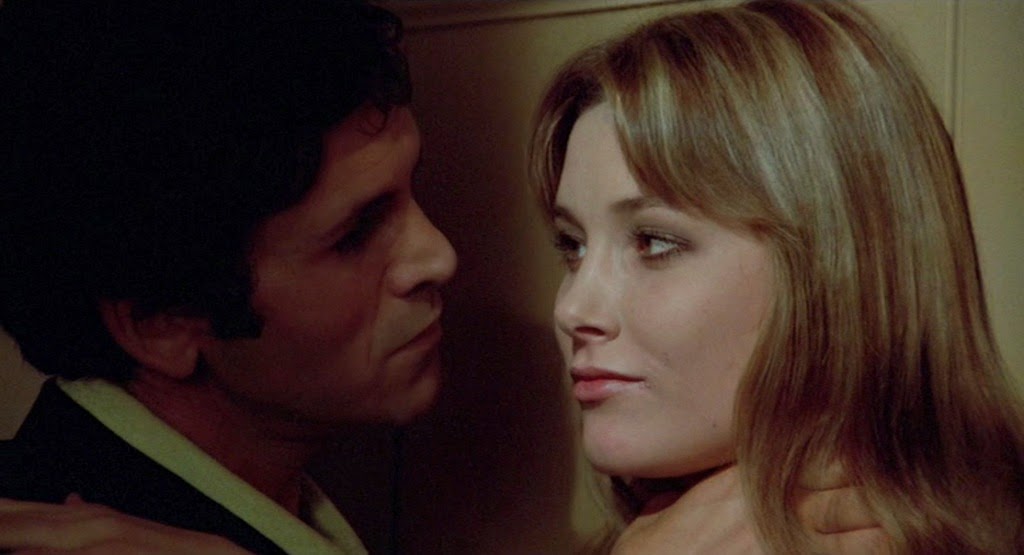
...but Tony appears somewhat more keen on romance


After a night on the town, Julie and Tony head back to her place, but the thugs who tried to kidnap her earlier are waiting for them. Tony gets a gun to his head and is forced to watch as the leader, a low-life named Hank (Ivano Staccioli), pins Julie to the sofa, rips her blouse open and puts a knife to her throat. It turns out they’ve mistaken Julie for her twin sister Mary, who has apparently stolen a one-million dollar diamond in London and then double-crossed her accomplices and made off with the diamond herself...


Julie and Tony are menaced by the baddies


In spite of its classic giallo title, The Devil with Seven Faces just barely qualifies as a giallo at all. It’s really more of crime-thriller with a couple of double crosses and surprise twists thrown in here and there, but unfortunately, it fails to provide much in the way of excitement regardless of what genre it belongs to. The main drawback is a tired and uninspired script (co-written by Tito Carpi and director Civirani), which is surprisingly uneventful and short on thrills – with an absurd amount of screen time devoted to showing the characters puff cigarettes or talk on the phone. Not helping matters are the hopelessly predictable twists that will come as a surprise to no one (the ‘big reveal’ about the twin sisters is telegraphed way in advance), and the script’s weaknesses are amplified by Civirani’s dull and pedestrian direction, which stops the feeble attempts at building suspense dead in their tracks.

The film on the whole is awfully tame, with the tone being set already in the ridiculous opening sequence in which Julie is stalked by a mysterious stranger who catches up with her and, instead of attacking her, merely whips out a camera and start snapping pictures of her – causing her to faint. It’s a terribly lackluster way to kick off the film and it fails to set up Julie’s stalkers as any serious threat to her well-being. At various later points in the film they make a half-hearted attempt to kidnap her, threaten her with a knife or force her head into bathtub full of water but with Civirani’s ham-fisted direction there’s never any real excitement and one never fears that Julie will come to any lasting harm.

Compensating for the aforementioned dreariness is a pretty awesome cast, although none of the actors are utilized all that well. Carroll Baker’s leading turn in Romolo Guerrieri’s hugely successful The Sweet Body of Deborah (1968) led to her starring in a string of gialli in which she played sexy damsels in distress who may or may not be as innocent as they first appear. By 1971, however, Baker had clearly grown rather tired of such roles, which her largely disengaged performance in The Devil with Seven Faces is ample proof of. She’s mostly phoning it in here and couldn’t even be persuaded to provide some nudity this time around. George Hilton – who had made his giallo debut alongside Baker in The Sweet Body of Deborah – was even more of giallo superstar at this point, but unlike Baker, he doesn’t seem to have tired of such films. The script admittedly gives him nothing to do but to rehash his old act as the shifty-faced Latin lothario (with plenty of close-ups of him doing shady expressions to make us ponder whether he’s a goodie or a baddie), but at least he looks great in his chic designer clothes.


George Hilton puts on a sinister face for the camera


This is a risqué as Carroll Baker was willing to get this time


The one that comes off the best is Stephen Boyd as Baker’s lawyer friend. Irish-born Boyd is best known for his excellent performance as Messala in the legendary Hollywood epic Ben-Hur (1959), but his career started dwindling in the late 1960s – propelling him into a period of doing European B-movies that would last until his premature death of a heart attack in 1977. He’s clearly not taking himself too seriously here, but his relaxed demeanor and natural charm serve him well and he’s a great asset to the film.


Stephen Boyd's suave charms and relaxed attitude is one of the film's saving graces


The cast also includes the lovely Lucretia Love, who is pretty wasted as Baker’s secretary, and the always welcome Franco Ressel as a police inspector, while beloved character actors Luciano Pigozzi, Daniele Vargas and Ivano Staccioli play various low-lives out to get their hands on the million dollar diamond. They don’t get a lot to do, but they’ve got the perfect faces for their parts and their sheer presence adds to the enjoyment.


The great Luciano Pigozzi can always be relied on to provide some good fun


Thankfully, the film offers a few other redeeming features as well. A rare stand-out sequence occurs when Baker hears strange noises and decides to explore a dark, cob-webbed attic – with nothing but a cigarette lighter to light the way for her – and happens upon a corpse. It’s an atmospheric and well-crafted sequence, but it undeniably feels as though it has been shoehorned into the film for no good reason other than to have a dead body turn up. Additionally, the climax at an old, deserted windmill is also reasonably effective and offers a couple of mild thrills.


One of the film's more atmospheric moments


The climax where a scantily clad Baker is menaced in an abandoned windmill is good fun


Another strong asset is the loungy, delightful score by the always excellent Stelvio Cipriani, featuring wordless vocals by the great Nora Orlandi. It's also a pretty nicely shot film and the Amsterdam locations are great, though somewhat underused.


If that’s not enough to keep your interest up, there’s always some unintentional fun to be had in the form of silly dubbed dialogue, a ridiculous-looking car chase with speeded up footage, and some hilariously unsubtle product placement (all of the characters are constantly smoking and there are more close-ups of cigarette packs than I was able to keep track of). But the biggest WTF moment by far is when a knife-wielding guy in a gorilla mask enters Carroll Baker’s office and scares her half to death before revealing himself to be her pranking Asian work colleague who grinningly tells her “I gweat authowity on howwow stowies!” It’s like a little precursor to the infamous jump scare sequence in J.P. Simon's Pieces (1982) in which Lynda Day George is inexplicably attacked by an Asian guy who then blames his violent outburst on some bad chop suey.


The pictures speak for themselves, really!


Hardly a scene goes by in this film without the actors puffing away on some Peer Export cigarettes. I wouldn't be surprised if that's where a large chunk of the film's budget came from


And, as expected, the (then) trendy design and fashion tastes on display are another source of constant amusement. Apparently, nothing was considered too much when it came to fashion back in the early 1970s, and “less is more” was a clearly a term unheard of. Gialli are the ultimate showcase for the period’s stunning lack of restraint, and The Devil with Seven Faces is no exception as it is ripe with amazing mod fashions, oversized table lamps, hideous abstract art, and a seemingly endless supply of wigs. Carroll Baker and Lucretia Love keep changing in and out of wigs for no good reason at all – some of which are sexy, while others are hilariously unfitting. The pièce de résistance is surely the blue, braided one worn by Baker while she’s sunbathing on a beach together with a suited Stephen Boyd. Big kudos to Boyd for keeping a straight face throughout that insanely absurd scene!


Julie's office is a real sight to marvel at. Just look at that floral painting and the yellow table lamp!


No comment necessary!!


There's definitely no shortage of horrible art and funky wigs on display


I can't possibly recommend anyone to seek out a film as lackluster as The Devil with Seven Faces, but for all its flaws, it also does have its weird charms, so I guess you'd might as well give it a spin on a rainy day. But keep your expectations low.


© 2015 Johan Melle


The cast:


Carroll Baker as Julie Harrison/Mary Harrison


George Hilton as Tony Shane


Stephen Boyd as Dave Barton


Lucretia Love as Margaret


Daniele Vargas as James Marlowe


Franco Ressel as Inspector Rinkel


Luciano Pigozzi as Steve Hunter


Ivano Staccioli as Hank


Robert Messina as A henchman
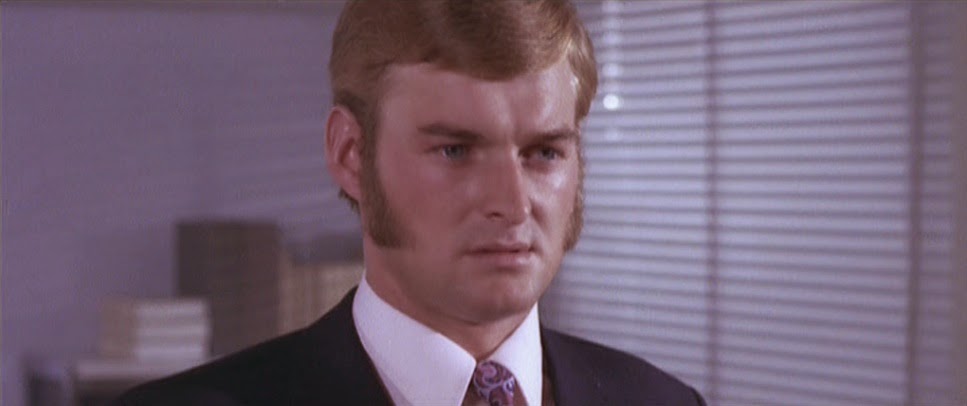

??? as Sgt. Van Doren


??? as Dave's secretary


??? as A henchman


??? as Mrs. Horst


fredag 1. august 2014

The Killer Reserved Nine Seats/L'assassino ha riservato nove poltrone


Italy, 1974

Directed by Giuseppe Bennati

Cast:
Chris Avram, Rosanna Schiaffino, Paola Senatore, Gaetano Russo, Eva Czemerys, Lucretia Love, Andrea Scotti, Howard Ross, Janet Agren, Eduardo Filipone


It’s finally time for new review, and this time I’ll be looking closer at the fairly obscure giallo The Killer Reserved Nine Seats. This film has just made its worldwide debut on both DVD and Blu-ray, courtesy of German company Camera Obscura, so this seems like the perfect occasion to revisit this interesting little film.

The filthy rich Patrick Davenant (Chris Avram) is celebrating his birthday along with his friends and family, and in the middle of the party, someone comes up with the idea that they should go visit a long closed down, old theater owned by Patrick and continue the partying there. The film begins just as Patrick arrives at the remote and abandoned theater with the rest of the group, which consists of his much younger fiancée Kim (Janet Agren), an aspiring actress who only wants him for his money; handsome but misogynistic painter Russell (Howard Ross), who also happens to be Kim’s secret lover; Patrick’s fiery-haired and acid-tongued daughter Lynn (Paola Senatore), who is disturbingly prone to kissing her father on the mouth; Lynn’s shifty-eyed and unlikable boyfriend Duncan (Gaetano Russo); Patrick’s frosty lesbian sister Rebecca (Eva Czemerys) and her ditzy, blonde lover Doris (Lucretia Love); Patrick’s elegant ex-wife Vivian (Rosanna Schiaffino), who is obviously still in love with him; and Vivian’s new husband Albert (Andrea Scotti), a stiff-lipped physician who is terribly jealous of Patrick. The atmosphere is generally unpleasant as none of the celebrants like each other very much, and keep throwing nasty comments at each other.


The guests arrive


Birthday boy Patrick


The adulterous fiancée and her lover


The obligatory lesbians


Patick's daughter and her sleazy beau


The elegant ex-wife in her amazing spider web dress


Also among their number is a mysterious young man in a Nehru shirt (Eduardo Filipone) who nobody seems to be quite sure who is – each of them assuming he’s a friend of one of the others. The strange, young man even claims to have spent the night in this very theater exactly one hundred years ago – a peculiar comment that none of the others seem to give a second thought as they are much too occupied with bickering over various petty feuds and jealousies.


The mystery man in the Nehru jacket


Things take a definite turn for the worse when someone with black leather gloves cuts the rope holding a heavy wooden beam, which then comes crashing down and is just inches away from crushing Patrick to death. Patrick quickly starts pointing the finger at his friends and family members, who are all financially dependent on him in one way or the other, and would benefit greatly from his demise.


A classic, black-gloved figure attempts to dispose of Patrick


The accusations are interrupted, however, when the vain Kim puts on an old theater costume and gathers the group to watch as she mounts the stage to recite the tragic finale from Romeo and Juliet. At the end of her performance, Kim stabs herself with a prop dagger and slumps dead to her knees as the others applaud her performance. But when Kim fails to get back up to accept her round of applause, the others are shocked to discover that she actually dead for real – someone behind the curtain having planted a dagger in her back while they were all watching!


The sequence where Kim is murdered on stage in front of her oblivious friends who assume everything is a part of her act appears to have had a strong influce on Michele Soavi's Stagefright (1987), which features a rather similar, though admittedly more effective, scene


As expected, Kim’s death puts a serious damper on the party, and everyone is eager to get the hell out. That, however, turns out to be easier said than done, as the phone has been disconnected and all of the doors sealed shut by some inexplicable force. With everyone trapped inside the theater, it doesn’t take long before they are picked off one by one by a mysterious killer wearing a cape, black leather gloves and a disturbingly creepy theater mask.


The doors won't open and there's no way out...


...which means the cast will soon fall prey to this guy with the seriously creepy mask


In the library, Patrick discovers an old parchment illustrated with macabre depictions of murder. Strangely, these images appear to foretell the order and method of which they will all be murdered. A growingly paranoid Patrick fears that an old family curse is responsible for the gruesome events, and apparently it all has something to do with what happened in this theater 100 years ago. Will any one of the guests make it out alive...?


The trapped guests are killed one by one...


...apparently in accordance with the illustrations from this strange, old parchment


The plot about a group of people being trapped in an isolated location and murdered one by one in accordance with images from a strange parchment is obviously inspired by Agatha Christie’s classic novel Ten Little Indians, which has served as the template for several gialli, including Mario Bava’s Five Dolls for an August Moon (1970) and Ferdinando Baldi’s Nine Guests for a Crime (1977). And indeed, The Killer Reserved Nine Seats also starts out as a typical Christie-style drawing room mystery, but fortunately, writers Biagio Proietti, Paolo Levi and co-writer/director Giuseppe Bennati give their own spin on the story by adding several distinct horror touches and a bizarre and unexpected supernatural plotline. Earlier gialli such as The Night Evelyn Came Out of the Grave (1971) and The Etruscan Kills Again (1972) also toyed with supernatural plot elements but in the end, a human culprit was revealed to have staged the whole thing. As such, The Killer Reserved Nine Seats stands as one of the very few gialli to actually uphold its supernatural elements throughout the film – thereby putting a strong individual stamp on the proceedings.

The writers also make sure to liven up the film with regular doses of sleaze and unwarranted (but welcome) nudity, as well as a couple of creatively nasty killings in which the female victims are stripped naked and disposed of in sadistic fashion – the definite highlight being a scene in which a particularly unfortunate victim is stabbed repeatedly in the crotch before getting her hand crucified to a wooden post. While this scene implies far more than it actually shows, it is still an extremely vicious and wince-inducing moment that culminates in the film’s most famous and memorable imagery.


By far the most famous shot in the film - reproduced for a lot of eye-catching artwork for the film


But as you can see, said artwork is always censored in the form of some added bras


Not much is known about the film’s director, Giuseppe Bennati, who made his start doing documentary shorts before graduating to feature films in 1951. He churned out a couple of comedies and melodramas in the 1950s and early 1960s – some of which were pretty well-received in their time – but then dropped off the map completely. The Killer Reserved Nine Seats – Bennati’s first and only foray into thriller/horror territory – was in fact his first film in 12 years, and it was also to be his last as he never made another film before his death in 2006. Given Bennati’s lack of experience with suspense films, it seems reasonable to credit a fair share of the film’s pleasing horror content to top-billed screenwriter Biagio Proietti, who had extensive experience in writing mystery thrillers for television, such as the highly successful Coralba (1970). But that’s not to undermine the contributions of Bennati, who does a very solid job of putting the script’s ideas up on the screen.

Possibly, the fact that Bennati’s other works were made in the 1950s and 60s might explain why this film discards with the modern urban settings found in most gialli in favor of an isolated castle-like setting, which evokes quite a bit of a gothic atmosphere similar to that of the early black-and-white gialli. Instrumental in bringing this gothic atmosphere to life is the genuine theater location and the carefully arranged production design, which makes for a baroque and striking backdrop to the tragic and violent proceedings, which are captured in loving and stylish detail by cinematographer Giuseppe Aquari (An Angel for Satan, 1966; Something Creeping in the Dark, 1971).

One of the best-looking moments is the sequence in which the doomed characters stare in terror as a ghostly voice recites a passage from Hamlet from an empty stage while a mysterious wind rattles the colorful curtains. It’s a great scene that is beautifully photographed and draped in atmosphere. Equally great is a supremely creepy scene in which the beautiful Lucretia Love explores a dark, shadowy room stashed full of old chairs, and as she moves, her shadow slowly glides across a chair – revealing that the killer is quietly sitting there.


A ghostly voice speaks from the empty stage in this wonderful little sequence


Lucretia Love explores a dark, sinister room in one of the film’s creepiest scenes


A gliding shadow quietly reveals the killer’s presence in this terrific shot


A notable recurring motif in the film is its striking use of mirrors, which is used to create stylish images and bring depth to the compositions. This is evident, for example, in several instances where mirror images are used to quietly reveal a character entering the room; and best of all in a terrific sequence in which the ravishing Paola Senatore suddenly decides to do a topless dance for no good reason whatsoever, and the mirror behind her reflects not only Senatore’s dancing, but also the image of another mirror in front of her.


A very nice shot in which a mirror is used to reveal Eduardo Filipone’s entrance in the room as he startles Rosanna Schiaffino by sneaking up on her


You may not notice it on the first viewing (and understandably so) but this is a terrifically composed shot that makes excellent use of two mirrors to bring depth to the frame


The Killer Reserved Nine Seats is definitely one of those films where the actors take a backseat to the atmosphere and the killings, but Bennati has nevertheless assembled some solid and recognizable performers whose presence here is most welcome. The best-known faces in the cast to fans of Italian B movies are probably Janet Agren and Howard Ross, who both get bumped off early in the proceedings – leaving most of the spotlight to Romanian-born Chris Avram as the tormented Patrick, and 1960s starlet Rosanna Schiaffino as his longing ex-wife. Avram – well-known for his performances in such other gialli as A Bay of Blood (1971) and So Sweet, So Dead (1972) – is solid in the leading role and brings the necessary gravitas to the part, whereas Schiaffino – by far the biggest name in the film at the time it was made – lends both charm, elegance and vulnerability to what is the film’s only really sympathetic character. The one that really steals the show, however, is the great Paola Senatore, who is just spectacular here – whether she’s delivering snarky comments or doing drugs and dancing naked.


Rosanna Schiaffino and Chris Avram get the most screen time...


...but it's Paola Senatore who steals the show. No question about it!


The remaining actors don’t get too much to do here but Gaetano Russo of Crazy Desires of a Murderer (1973) and the ultra-trashy Trhauma (1979) is always convincing as a major sleazebag and his performance as Senatore’s boyfriend is no exception. The sexy Eva Czemerys as Avram’s lesbian sister is used mostly decoratively, but her regal posture, frosty demeanor and catty gaze keeps one glued to the screen. Blonde American-born starlet Lucretia Love is somewhat less fortunate as Czemerys’ lesbian lover because she is easily the stupidest character in the film. The camera, however, loves her – framing the photogenic, wide-eyed and expressive actress in a series of stunning close-ups.


The camera is in love with Lucretia Love


But in spite of its major draws, The Killer Reserved Nine Seats is certainly not without its share of faults, the chief of which is the lack of any likable characters. Not even the imminent threat of a brutal murderer is able to prevent these people from bickering and bombarding each other with snarky comments (“You mean son of a bitch! I hope you're the next victim!” etc), and whenever they’re not busy bitching, they engage in unlikely activities such as consuming drugs, having sex or stupidly wandering off on their own to get killed. While one might argue that this adds to the overall fun, the characters’ moronic behavior also makes it hard to really root for any of them. The constant arguing over things from the past also tends to bog the film down with a lot of dialogue which does little to develop any of the cardboard characters much.


What you do to pass the time when you’re locked in and there’s a sadistic killer on the prowl


It is also regrettable that nothing more is made of the old parchment with macabre illustrations that foretell the order and method of each murder. This idea – while clearly cribbed from Ten Little Indians – is a nice little touch that could have been used to creepily foreshadow the killings, but instead it’s forgotten about almost immediately and we don’t even get to see more than three of the parchment’s illustrations up close. A wasted opportunity!


The sadly under-used parchment


In spite of these reservations, The Killer Reserved Nine Seats is for the most part a sleek-looking and enjoyable film that benefits tremendously from its atmospheric locations, sleazy thrills and an interesting script which takes what initially appears to be a standard drawing room mystery and spins it in all kinds of unexpected directions. It makes the film unpredictable, and you’d be hard pressed to guess the final solution to the mystery before it’s revealed at the end.


After decades of being available only through fuzzy-looking VHS tapes or even worse-looking bootlegs of said tapes, Camera Obscura’s DVD and Blu-ray release of this obscure giallo comes as a very welcome treat. And let me tell you, this is an excellent release that finally does the film justice! I won’t bore you with technical details because I’m not particularly good at that stuff and I’m more interested in the actual films anyway, but in short this is a clean, detailed and stunning transfer. Based on my initial viewings of the film through various bootlegs, I didn’t consider it to be all that stylishly shot, but seeing it for the first time in excellent condition has forced me to reconsider. This really is a good-looking and well-photographed film, and this release serves as a potent reminder of just how big a difference a solid transfer can make!


Just two examples of the many wonderfully composed and lit sequences which can finally be appreciated in all their glory


Also, you get both English and Italian audio with optional English subtitles. Always love it when they give us a choice! Both tracks are solid but I’ll give a slight edge to the Italian dub, which sounds a bit more sophisticated. The English dub has its share of silly dialogue, but for a lot of viewers this will undoubtedly just add to the fun. And, yes, a lot of the regular voice actors are present (I recognized Susan Spafford as the voice of Eva Czemerys, Silvia Faver as the voice of Janet Agren and Ken Belton as the voice of Andrea Scotti).

We even get a few nice extras – more than one would really expect for such an obscure film – starting with two great interviews with screenwriter Biagio Proietti and actor Howard Ross. Proietti provides valuable insight into the Italian screenwriting process of the 1970s and shares interesting memories of Giuseppe Bennati, while Ross offers nice recollections of Bennati and of his fellow cast members (his comments about Paola Senatore are particularly amusing). Ross has aged incredibly well, by the way, and is still looking very sharp. The main extra is an audio commentary by Marcus Stiglegger and Kai Neumann, who provide a lively and engaging in-depth discussion in which they are able to find a perfect balance between serious analysis and jokier parts in which they point out film’s sillier elements. A couple of their analytical points do strike me as a bit far-fetched (I’m not at all buying their argument that the theater setting gives the film a meta-perspective) but on the whole this is an insightful and engaging commentary that is well worth listening to. Oh, and there’s also a photo gallery which yours truly contributed to, and it was very cool for me to be able to contribute to this release – even if just in a small way.

Overall a very nice release of a very nice giallo. If you’re a giallo fan you need to get this!


© 2014 Johan Melle


The cast:


Chris Avram as Patrick Davenant


Rosanna Schiaffino as Vivian


Paola Senatore as Lynn Davenant


Gaetano Russo as Duncan Foster


Eva Czemerys as Rebecca Davenant


Lucretia Love as Doris


Andrea Scotti as Albert


Howard Ross as Russell


Janet Agren as Kim


Eduardo Filipone as The Mystery Man