Viser innlegg med etiketten patrizia viotti. Vis alle innlegg

tirsdag 7. juli 2015

La morte scende leggera


Italy, 1972

Directed by Leopoldo Savona

Cast:
Stelio Candelli, Patrizia Viotti, Veronika Korosec, Tom Felleghy, Fernando Cerulli, Antonio Anelli, Marcello Di Martire, Rossella Bergamonti, Franco Marletta, Lella Cattaneo


Leopoldo Savona was a bit of an oddball director whose career was made up mostly of low-budget spaghetti westerns, but he also made two attempts to tackle horror and thriller material – first with the stylish and underrated gothic horror film Byleth (1972) and then with the little-known giallo La morte scende leggera (translation: Death Descends Lightly).

The plot deals with shady drug trafficker Giorgio Darica (Stelio Candelli), who returns home from one of his “business trips” and finds his estranged wife Irina with her throat slashed. Fearing he’ll be the police’s number one suspect, Giorgio seeks help from Magrini (Fernando Cerulli), a corrupt magistrate he has dirty dealings with. Magrini and Giorgio’s shady lawyer Savara (Tom Felleghy) arrange for Giorgio to hide out in a temporarily abandoned hotel until they can set him up somewhere more permanently. Giorgio goes along with the plan but insists on bringing his mistress Liz (Patrizia Viotti) along to the hotel – against Savara’s wishes.


Giorgio


Giorgio seeks help from his big shot friends


At first, Giorgio and Liz seem to settle in well and enjoy spending their time relaxing, watching old porn loops on a projector, and having lots of sex, but it doesn’t take long before the confinements of the hotel causes boredom and paranoia to kick in. Liz starts questioning whether Giorgio has actually murdered his wife or not, and the two are soon at each other’s throats and arguing violently.


Sex and games at first...


...then boredom sets in...


...and finally hysteria


Things take a turn for the worse when it turns out that Giorgio and Liz are not alone at the hotel. In the middle of the night, Giorgio is awoken by strange sounds and heads downstairs, where he finds a middle-aged woman murdered – her throat slashed just like Giorgio’s wife. Suddenly, the hotel owner (Antonio Anelli) appears and matter-of-factly explains that the woman is his wife, whom he has just murdered because her jealousy was making his life unbearable. The strange hotel owner tells Giorgio that the two of them are in the same boat now and asks him to help dispose of the body – to which Giorgio reluctantly agrees, but the hotel owner’s bizarre behavior soon has him questioning his own sanity and whether or not what is happening is actually real.
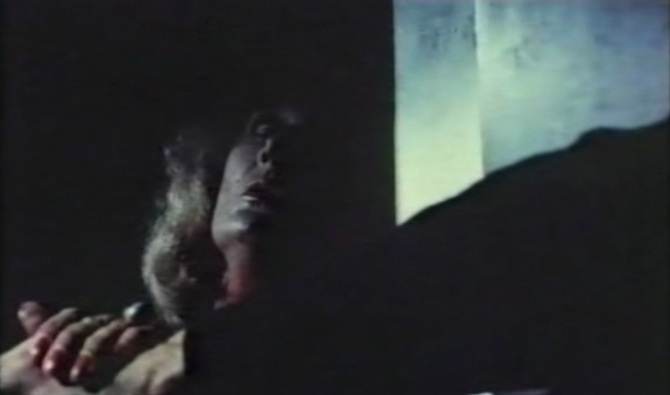


Murder!


Giorgio becomes an unwilling accomplice


Complicating matters further is the sudden arrival of the mysterious Adele (Veronika Korosec), who claims to be the hotel owner’s daughter, and who begins playing mind games with Giorgio and trying to seduce him. The increasingly distressed Giorgio is unable to tell whether Adele is real, or a figment of his imagination, or perhaps even a ghost. Has he gone mad? And is he the killer of his wife or not?


The mysterious Adele


Giorgio and Liz start to get freaked by all the strange going-ons


La morte scende leggera is another one of those little-seen gialli that has lapsed into obscurity and is currently circulating only through rips of an old Italian VHS with English fan subs slapped on top of it. Production of the film was originally announced in Variety back in June 1971 under the slightly longer title La morte scende leggera come un ragno (Death Descends Lightly Like a Spider), with spaghetti western star Robert Wood set to star alongside Patrizia Viotti. By the time it went into production, however, Wood had been replaced with Stelio Candelli. The film was eventually completed and approved by the Italian censorship board in August 1972 but for reasons unknown it did not hit Italian movie screens until two years later – making little impact at the box office and apparently never receiving an English dub. Interestingly, the blurb in Variety cites Aldo Marcovecchio – who had previously written The Night of the Damned (1971), which also starred Viotti, as well as Savona’s previous horror film Byleth (1972) – as the writer whereas the film’s opening titles credit the story to Luigi Russo and the screenplay to Russo and Leopoldo Savona, with no mention of any sort for Marcovecchio. It is still very much possible, however, that Marcovecchio had a hand in the script because the bizarre screenwriting traditions in Italy at the time meant that writers who contributed substantially to a film’s screenplay might end up receiving no credit at all while someone who had comparatively little to do with the finished script might end up receiving full credit for it.

As for the film itself, La morte scende leggera is another case of a rare giallo that has faded into obscurity for a reason. It starts out promisingly enough, with the seemingly abandoned hotel serving as a suitably sinister and claustrophobic setting for the action. But it doesn’t take long before the confinements of the hotel start to bore and frustrate the two main characters, and unfortunately, their boredom quickly rubs off on the viewers as Savona’s direction is languid and lacking in momentum. The ghostly twist is a welcome change of pace from the usual giallo routine, but Savona seems unsure about how to handle it, and the big climatic reveal is clumsily telegraphed early on. Still, the film isn’t necessarily all that bad – the real problem is rather that everything is so hopelessly indistinct. The cinematography by Luciano Trasatti is pretty slick, but for a giallo it is rather on the ordinary side. There’s none of the visual panache we’ve come to expect from these films, and likewise, there are no flashy or stylish murder set-pieces, or even the requisite kitschy fashion tastes – presumably a result of the visibly meager budget. Again, nothing is outright bad, but the execution is consistently half-assed.
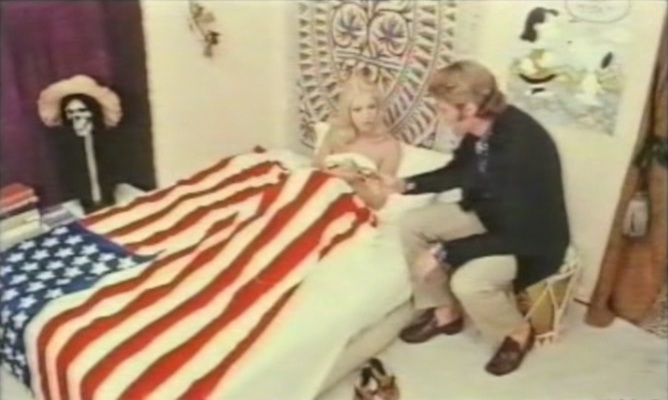

There’s an unfortunate lack of extravagantly silly fashion and décor choices but, thankfully, Liz’s ghastly decorated bedroom is an exception


Thankfully, there are some notable exceptions to the mediocrity which are able to redeem the film somewhat – most notably the soundtrack by Lallo Gori and particularly the cool, guitar-driven song “Sunday in Neon Lights” – performed by Ghanaian prog rock singer Mack Sigis Porter – which plays over the opening titles and which is repeated at various times throughout the film. This song was not written for the film (it is instead taken from Porter’s 1972 album “Peace On You”), nor did composer Gori have nothing to with it, but according to Quarter Records’ CD release of the film’s soundtrack, Gori nevertheless “designed his orchestration to match the song and creates a memorable, haunting tapestry of madness, mod and psychadelia”. Gori’s compositions do indeed match the song very nicely and together they help set a nice atmosphere and mood for the film. You can listen to the song yourself here:


Another priceless highlight is the scene where Giorgio and Liz are in bed watching a sex loop on an 8mm projector that Giorgio has very conveniently brought with him. You can’t go on the run without one of those! Anyway, what’s interesting is that the footage being shown on the projector is actually a recycled sex scene from Savona’s previous horror film Byleth (1972) featuring the beautiful Marzia Damon. This scene even gets a little meta on us when Liz asks if the loop is Italian and Giorgio informs her that Italy is producing more of this stuff than Sweden and Denmark.


Nothing sets the mood like some good 8mm porn


It is also interesting to note how the film foreshadows Umberto Lenzi’s Spasmo (1974) in the way it questions the sanity of its protagonist, although ultimately the film’s troubled release story resulted in the Lenzi film being the first to hit movie screens. The hotel setting and ghostly apparitions means that the film also manages to foreshadow Stanley Kubrick’s iconic The Shining (1980), though only on paper as the two films couldn’t possibly be more different in execution. If anything, the atmosphere of La morte scende leggera, with its zero budget look and confined setting, most of all resembles a Jess Franco film.


Casting for the film is somewhat odd – headlined by spaghetti western bad guy Stelio Candelli in one of his relatively rare starring roles. Candelli’s hard face and intense gaze made him an unusual choice for leading roles and as such he is a nice fit to play a shady crook like Giorgio. He’s not a particularly sympathetic protagonist, but the film deliberately plays on this by keeping the viewers in the dark about whether or not Giorgo has murdered his wife. The opening scene simply shows him exiting his apartment building looking all wild-eyed, sweaty and nervous, but it is unclear whether his agitated state is due to having just committed a murder or simply because he has just found his wife dead and is nervous about becoming a suspect. It’s a nice approach, but it never quite succeeds – largely because Giorgio is not only a rather unsympathetic character, but also a boring one. Candelli is a good actor and does a decent job, but there’s only so much you can do with such a thinly drawn and underdeveloped character.


Guilty? Or just nervous?


Filling the part of the female lead is the dour-eyed Patrizia Viotti, who gives off a rather unlikable vibe throughout the film, although it’s difficult to tell whether this is intentional or not. She is as quick to disrobe here as she was in Filippo Walter Ratti’s sexy-gothic horror film The Night of the Damned (1971) but her acting rarely rises above passable except for a well-done freak-out scene where she gets into a violent confrontation with Candelli.


Patrizia Viotti


The most familiar name in the supporting cast is surely that of Hungarian-born character actor Tom Felleghy, one of the most frequently employed actors at Cinecittà, with appearances in more than 200 Italian productions (be it western, giallo, horror, peplum, crime, comedy, Eurospy etc) but usually in small roles limited to a scene or two. The role of Giorgio’s shady lawyer allows Felleghy to take on a more substantial part than usual for him, and it is nice to see him get a fair bit of screentime even if the role itself is hardly all that exciting.


Tom Felleghy


La morte scende leggera might be worth a watch, I guess, as it has a couple of interesting moments and a terrific soundtrack, but this is definitely a lower-tier giallo, so approach it with low expectations.


© 2015 Johan Melle


The cast:


Stelio Candelli as Giorgio Darica


Patrizia Viotti as Liz


Veronika Korosec as Adele


Tom Felleghy as Attorney Savara


Fernando Cerulli as Magistrate Magrini


Antonio Anelli as Hotel owner


Marcello Di Martire as Commissioner De Carmine


Rossella Bergamonti as Marisa


Franco Marletta as Malvestiti, the film director


Lella Cattaneo as Hotel owner’s wife


søndag 19. april 2015

The Night of the Damned/La notte dei dannati


Italy, 1971

Directed by Filippo Walter Ratti

Cast:
Pierre Brice, Patrizia Viotti, Angela De Leo, Mario Carra, Antonio Pavan, Alessandro Tedeschi, Daniela D’Agostino


My craving for obscure European horror films apparently never seizes and now it’s time to look closer at The Night of the Damned directed by Filippo Walter Ratti (under the anglicized pseudonym Peter Rush), a comedy director whose career started in the 1940s but who today is remembered largely because of his brief brushes with horror and giallo territory in the twilight years of his career.


The plot is set somewhere in France and deals with sharp-witted journalist Jean Duprey (Pierre Brice), who has become famous after helping the police solve a high profile murder. His charming wife Danielle (Patrizia Viotti) seems impressed by all the attention bestowed upon her hubby but Jean himself couldn’t care less. His interest is raised, however, when he receives a cryptic letter from the prince Guillaume de Saint Lambert (Mario Carra), a once dear friend that Jean lost contact with years ago. Jean soon discovers that the letter contains a code leading to a couple of macabre passages from Charles Baudelaire’s poetry collection The Flowers of Evil. Danielle is confused since the Baudelaire passages don’t clarify anything but Jean explains that Guillaume has always been a bizarre character with a fondness for puzzles. He interprets the macabre passages as meaning that Guillaume’s life is in danger, and quickly drags Danielle along to go check up on his old friend.


Jean and Danielle try to decipher the cryptic letter


It turns out that Guillaume lives in an old, crumbling and supposedly haunted castle with no electricity installed. Danielle and Jean are greeted by Guillaume’s attractive wife Rita (Angela De Leo), who Jean has never met or heard about before, and she tells them Guillaume is gravely ill from a strange disease. Jean immediately runs to Guillaume and finds him in a morose and agitated mood. He claims his sickness is the result of a three centuries old family curse that afflicts all men of the Saint Lambert family when they turn 35 – striking them with a sickness that consumes them until their brains explode with madness. Guillaume then begins to speak in riddles about a horrifying truth but goes into a hysterical fit before he can reveal anything else.


Jean is reunited with the sickly Guillaume


Guillaume’s mysterious wife, Rita


Later at dinner, Rita tells Jean and Danielle that Guillaume’s illness is completely imaginary. Danielle is rather upset by the whole thing and when she’s about to go to bed she is greatly disturbed by an old drawing depicting a witch burning. In her sleep, Danielle sees the flames in the drawing come to life and she has a terrible nightmare about being burned alive as a witch.


An old drawing upsets Danielle...


...and leads to disturbing nightmares


Jean tries to talk to Guillaume again but he just keeps on speaking in riddles about a “horrible truth” that is hidden in the library. He finally agrees to tell Jean everything tomorrow but postponing the revelation of whatever forbidden knowledge one possesses until the next day is never a good idea in movies, so it comes as no surprise that poor Guillaume is found dead in his bed the next morning. Rita quickly throws together a rather ghoulish funeral ceremony in an eerie candle-lit crypt complete with white-hooded pallbearers.


Poor Guillaume’s macabre funeral


That same night a nubile young blonde is abducted and taken to a misty underground lair where Rita, who it turns out is a witch, sits on a dragon-headed throne and presides over a satanic ritual that involves her naked female servants engaging in a lesbian orgy with the kidnapped girl. At the end, Rita herself gets up and attacks the girl with her deadly claws. The next day, the poor girl’s naked, mutilated body is discovered not far from the Saint Lambert castle – her body having been drained completely of blood.


A hapless young woman is abducted...


...and meets her fate in Rita’s mist-enshrouded lair


The poor woman’s lifeless remains


The case is assigned to the bewildered Inspector Gérard, who quickly recruits Jean to assist in the investigation. In a puzzling turn of events, the victim is revealed to be Guillaume’s cousin and Jean is convinced that the key to the mystery is the “horrible truth” that Guillaume said was hidden in the castle’s library. As he obsessively searches for clues, Jean fails to notice that his increasingly unstable wife starts falling victim to Rita’s satanic powers. She is quickly bewitched into a lesbian affair with Rita, who has macabre plans for both Jean and Danielle...


Jean searches for answers in the castle library...


...and is completely oblivious to the fact that his wife is bewitched into a deadly lesbian affair


The Night of the Damned was Filippo Walter Ratti’s first attempt at making a horror film, and the script by Aldo Marcovecchio is molded in the then rather passé tradition of the Italian gothic horror films of the early 1960s but with vamped up visuals of steamy nudity and lesbianism to make it more appealing to an early 70s grindhouse audience. It comes with all the necessary ingredients for an Italo horror fan favorite but instead it vanished into obscurity due to the decades-long unavailability of an English-friendly variant as well as a full uncut version. The Night of the Damned was originally released in Italy in a heavily watered-down version that cut out nearly all of the graphic lesbianism. This cut was also released on Italian VHS on the Shendene label (running 83 minutes) and it has been the most commonly seen version of the film – thus damning it to a similar fate as that of Ratti’s next film, the forgotten giallo Crazy Desires of a Murderer (1973), which also contained a series of explicit sex scenes that were hacked out by the Italian censors. But unlike the uncut version of Crazy Desires of a Murderer, which is probably lost forever, the naughty bits excised from The Night of the Damned still exist since a steamier version was prepared for export to countries with more relaxed censorship policies. There’s a French VHS release under the title Les nuits sexuelles, which contains a whooping 12 extra minutes of graphic lesbianism. However, this version is actually ten minutes shorter than the Shendene tape due to the elimination of a significant number of plot and dialogue scenes – making it somewhat of a bastardized ‘sexy version’ of the film. Thankfully, some kind soul has created a composite variant by adding the naughty bits from the French version to the censored Italian cut as well as adding English subtitles. A most welcome treat indeed, even if the steamier parts are in dire shape.


A few scenes from the stronger ‘sexy version’ in rather grotty quality


The film’s more graphic content also survives in the form of a photo-novel version published in the magazine Bigfilm, which devotes ample space to the many scenes of explicit lesbianism.


Some assorted scans from the rare photo-novel version, which strongly emphasizes the sexual content


An English-language version was also prepared, with dubbing expert Ted Rusoff in charge of adapting the dialogue to English and directing the dubbing. This version was released in the UK (after being cut by the BBFC in order to achieve an X rating) by Butcher’s Film Service, who paired it on a double bill with another Italian horror film: Mario Colucci’s Something Creeping in the Dark (1971). Surprisingly, the English-dubbed version never surfaced on VHS anywhere in the world, constituting the main reason why The Night of the Damned has remained obscure for many years. The film’s distribution rights are currently owned by Movietime but the description in their online catalogue only lists an 85 minute Italian-language version. Sadly, this indicates that they do not have elements for the steamier scenes cut from the Italian print, and it probably also means that the English dub track is lost. In other words: the currently circulating fan version may well be the best version we’re ever going to get.


As for the film itself, it is an interesting and atmospheric if not entirely successful slice of sleazy gothic horror. Its main drawback is that the lesbian sex scenes are drawn out to the point of near ludicrousness – stopping the film dead in its tracks for long stretches of time. The censored Italian cut is actually more agreeably paced but cannot be recommended due to its lack of frisson. In other words, the composite uncut version is still the way to go even if the repetitive, drawn out nature of the sex scenes do work to its disadvantage.


The film also suffers from a distinct lack of originality, with the basic premise playing like an amalgamation of Edgar Allan Poe’s The Fall of the House of Usher and J. Sheridan Le Fanu’s Carmilla, complemented by a host of familiar satanic and haunted castle clichés. But as long as you are able to overlook these misgivings, The Night of the Damned offers a series of finer points that work in its favor. The film is above all stylish and colorful to look at – starting with the wonderful credits sequence, which features flickering flames superimposed over still shots of the actors drenched in vivid Mario Bava-esque red and green lighting while the enchanting title song from Amando De Ossorio’s Malenka the Niece of the Vampire (1968) plays.


A few images from the gorgeous, Bava-esque title sequence


A similarly striking use of color lighting is later employed in a satanic orgy scene in which we see Rita sitting on her throne while a column of vibrant pink smoke rises from a cauldron next to her and imbues the screen in a pink hue. It’s just too bad that the film doesn’t experiment more with this type of stylish lighting. Instead it frequently opts for the more traditionally gloomy lighting that one typically associates with such old-dark-house movies and this approach admittedly works as far establishing classic gothic atmosphere goes.


Some dazzling use of sparkling colors


More classic gothic imagery


One particularly intriguing aspect to the story is the employment of cryptography, anagrams and poetry by Baudelaire as clues to solving the film’s mystery. This hints that The Night of the Damned was originally intended for a more sophisticated target audience but the way it ultimately turned out, these plot points are somewhat lost in the shuffle among all the lesbian shenanigans. Likewise, the fact that Rita is draining her female victims of their blood – apparently to retain an eternally youthful appearance, Elizabeth Báthory-style – opens the door for a vampiric edge, but it is never made explicit, and nothing much ever comes from this potentially interesting plot point.


Rita puts her deadly claws to use and drains her victim of blood


Even though the film never explores its vampiric theme, this newspaper ad misleadingly plays up that angle with the following tag line: “A mysterious castle: vampires, hallucinations, horrors! The countess Dracula in the latest and most chilling film of Terror!!!”


Still, while the film may miss out on the opportunity to explore the above plot points in a fully satisfactory fashion, one should appreciate the fact that they are there at all, as they do put a bit of a refreshing spin on the proceedings. And so do other memorably bizarre little moments scattered throughout the film, such as a scene in which the sickly Roderick Usher-esque Guillaume is talking to Jean and we see the image of a skull momentarily superimposed over Guillaume’s face. Hardly the most subtle way to signalize him as doomed but it is nevertheless a strange and eerie image that stands out. Other memorable and well-staged sequences include the macabre funeral procession and scenes down in Rita’s smoky, cobwebbed crypt – well helped by Girolamo La Rosa’s stylish cinematography and lighting, which makes good use of the medieval castle setting to create a delightful gothic atmosphere.


The rather bizarre skull scene


Rita’s misty underground crypt is a stylish, delightful sight


The interesting cast is led by handsome French actor Pierre Brice, who became a superstar in Germany in the 1960s due to his role as the Apache-chief Winnetou in a long line of popular German films based on the novels by Karl May. As the popularity of the Karl May adaptations began waning by the late 1960s, Brice tried to break free of the Winnetou image, and while he never quite managed to do so, his attempts saw him pop up in a couple of interesting French and Italian productions during the 1970s. The Night of the Damned was, however, not entirely new territory for Brice, who had already starred in Giorgio Ferroni’s stylish Italian gothic horror classic The Mill of the Stone Women (1960) way back in his pre-Winnetou days. Here, however, he’s not really at the top of his game – at times looking both a little bewildered and out of place while Ratti focuses most of his attention on the attractive female cast.


A slightly bewildered-looking Pierre Brice


Cast in the female lead as Danielle is well-shaped, blonde starlet Patrizia Viotti, who had started her career by appearing nude in erotic photo-novels while she was still underage, and who became a favored object of the yellow press due to a scandalous and highly publicized romance with British-born singer Mal in 1969. This propelled Viotti into a busy movie career in the early 1970s that started with the erotic film Erika (1971), which – like The Night of the Damned – was directed by Filippo Walter Ratti and paired Viotti with Pierre Brice. She also appeared in a small but pivotal part as Barbara Bouchet’s lesbian lover in Silvio Amadio’s enjoyable giallo Amuck (1972), was the female lead in Leopoldo Savona’s rather dismal giallo La morte scende leggera (1972), and appeared in a few decamerotic films before dropping off the scene almost as quickly as she had appeared. When watching The Night of the Damned it is easy to see why. Viotti simply wasn’t a particularly good actress – hampered by both a wooden demeanor and lack of expressivity. It’s obvious that she was put in movies simply because of her notoriety in the gossip pages and once that dried up, so did her career. Tragically, Viotti quickly fell on hard times – getting involved with drugs and being arrested numerous times – before passing away in 1994 at just 44 years old.


Patrizia Viotti in full scream queen mode


The most appealing presence in the film is unquestionably the mysterious witch played by the gorgeous, raven-haired Angela De Leo – best known for starring in a series of photo-novels (of both the romantic and the sexy variant). Clad in black gowns and with heavy eye-make up, she always has the same fixed expression and icy stare while the camera photographs her in under-lit tones to make her appear more sinister and mysterious. This gives De Leo a truly striking and uncanny appearance that commands attention, and she is used effectively even if she doesn’t do that much actual acting.


The ravishing Angela De Leo - heavily made-up and carefully lit at all times


While far from a lost classic, The Night of the Damned is just atmospheric and sleazy enough to keep fans of such movies diverted throughout its running time. You could definitely do a lot worse than this nice-looking little flick.


© 2015 Johan Melle


The cast:


Pierre Brice as Jean Duprey


Patrizia Viotti as Danielle Duprey


Angela De Leo as Rita Lernod


Mario Carra as Guillaume de Saint Lambert


Antonio Pavan (???) as Inspector Gérard


Alessandro Tedeschi as Professor Berry


Daniela D'Agostino as The maid