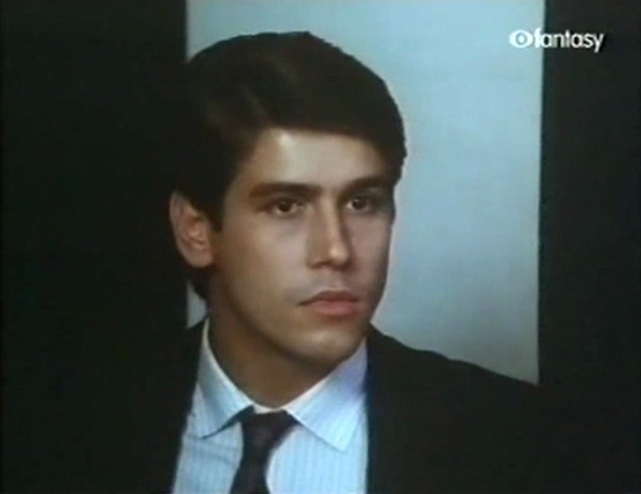
Italy, 1989
Directed by Lamberto Bava
Cast:
Tomas Arana, David Brandon, Carole André, Ulisse Minervini, Joyce Pitti, Marina Viro, Pascal Druant, Virginia Bryant, Augusto Poderosi
Directed by Lamberto Bava
Cast:
Tomas Arana, David Brandon, Carole André, Ulisse Minervini, Joyce Pitti, Marina Viro, Pascal Druant, Virginia Bryant, Augusto Poderosi
Italian horror films from the late 1980s are generally not held in very high esteem – being frequently dismissed as the last, uninspired death throes of this once blossoming genre. And, indeed, some pretty lousy Italian horror films were churned out in this period but others again were surprisingly good. What is most surprising, however, is perhaps the sheer volume of Italian horror film being produced between 1987 and 1989. The Italian film industry was in increasingly bad shape at this point, and yet producers kept green lighting one flashy-looking, special effects laden horror flick after the other. Presumably, one of the reasons for this was the growing emergence of fanzines covering Italian horror movies. All of a sudden directors like Mario Bava, Dario Argento and Lucio Fulci were starting to be recognized for their style and talent. This rising interest in Italian horror also caught the attention of the filmmakers themselves, who soon decided to take advantage of their newfound appreciation. For example, Fulci lent his name to a series of cheap and gory horror films, which were released under the moniker “Lucio Fulci presents”.
Unfortunately, this new Italian horror boom would prove to be short-lived but it did produce a number of interesting films. One of the more intriguing aspects to some of the horror films from this period is a new sense of playfulness and self-referentiality: in Andrea Bianchi’s Massacre (1989), the cast of a cheap horror movie are being murdered one by one; in Luigi Cozzi’s The Black Cat (1989), a famous horror movie director unleashes an evil witch when he attempts to make the third installment in Dario Argento’s then-unfinished trilogy of ‘The Three Mothers’; and in Lucio Fulci’s A Cat in the Brain (1990), Fulci stars as himself – a horror movie director being haunted by visions inspired by his own gory films.
Made in the same self-referential spirit as those films is Lamberto Bava’s The Prince of Terror, one of the four TV horror movies helmed by Bava under the moniker High Tension, of which I have previously covered School of Fear and The Man Who Didn't Want to Die. The film begins on a foggy night. An attractive young woman (Marina Viro – dubbed by the ever-present Carolynn De Fonseca) is sleeping in an RV camped in the woods when she is suddenly awoken. She is worried because she can’t find her boyfriend so she steps out – wearing nothing but her nightie – to look for him. To her horror she finds him dead, and worse yet, the corpse turns into a bloated zombie creature right in front of her eyes. The zombie-boyfriend is quick on his feet, though, and starts chasing his terrified girlfriend through the woods!


Zombie mayhem!
But then suddenly we hear someone yell “Cut!” and it turns out that we have just witnessed the shooting of the latest film by Vincent Omen (Tomas Arana), a famed horror movie director who has been nicknamed the ‘Prince of Terror’ by the press.

The Prince of Terror at ease in the director’s chair
But Vincent is not at all happy with how the film is coming along. He finds the screenplay to be ridiculous and demands that it be re-written – much to the chagrin of his long-time script writer Paul Hillary (David Brandon), who refuses to make any changes. Vincent, however, will not budge, and gives the film’s producer (Pascal Druant) an ultimatum: either he finds a new screenwriter or Vincent will abandon the whole project. Under such circumstances, the producer has no choice but to oblige, and a bitter Paul finds himself out of a job.

Writer and director clash on the set
Off set, Vincent lives in a fancy villa adorned with creepy props from his films, but for the most part he leads a pretty quiet and normal life together with his beautiful wife Betty (Carole André) and their young teenage daughter Susan (Joyce Pitti), who always carries her pet dog Demon (!) around.

The Prince of Terror enjoys a tender moment with his charming wife

Vincent’s daughter with her pet dog
All is not well, however, as Vincent is receiving some creepy anonymous phone calls, and soon disturbing things are happening such as the toilet overflowing with blood!


That bloody toilet!
But that’s just the beginning. Things take a turn for the worse when poor Susan goes to pick up her dog from the sofa but to her horror she pulls its skin off – leaving a flayed, gory carcass on the sofa.


Demon the Dog meets a grisly end in this cheesy yet delightfully vicious scene
The shocked family put the dead dog in the garbage can but soon afterwards someone throws it back through the window and then the power goes out. Vincent decides to search through the premises, but in the meantime the mysterious tormentor breaks into the house and takes both Betty and Susan captive. The culprit is revealed to be Eddie Felsen (Ulisse Minervini – dubbed by the great Ted Rusoff), a former actor who used to work for Vincent until his face was badly burned in a fire on a movie set. The now deranged Eddie blames Vincent for the accident and intends to make him and his family suffer. However, he has not been alone in setting up this brutal home invasion. No, the real mastermind behind the plot is Paul, the jilted screenwriter, who quickly reveals himself as a sadistic maniac who will stop at nothing to get his long-awaited revenge on Vincent.
The terrified family try their best to fight their captors and escape from the villa but Paul is always one step ahead of them. He continues to torment them in various cruel ways, and in a clever twist, all of the sadistic tricks he pulls off are actually based on old, unused script ideas which were axed by Vincent. Paul is eager to prove to that his ideas are much more effective and terrifying than they were given credit for, and Vincent and his poor family are going to experience it first-hand...


The Omens experience a night of terror
The Prince of Terror was written by the well-known horror movie writer Dardano Sacchetti, who is fondly remembered for his long and fruitful collaboration with Lucio Fulci. Sacchetti wrote Zombie (1979), City of the Living Dead (1980), The House by the Cemetery (1981), The Beyond (1981), The New York Ripper (1982) and Manhattan Baby (1982) for Fulci but their working relationship eventually soured and ended rather bitterly. Clearly, Sacchetti’s difficult relationship with Fulci formed the inspiration for the film’s story, and it’s difficult to not view The Prince of Terror as a critique of how many directors unfairly take all the credit for a film’s success. With that said, the extreme behavior exhibited by the film’s vengeful screenwriter character suggests that Sacchetti’s criticism is not meant to be taken too seriously. In fact he manages to keep it fairly tongue in cheek, and throws in some amusingly witty dialogue exchanges where Paul and Vincent debate what constitutes a good horror movie. One of the highlights is their argument at the start of the film where Vincent accuses Paul’s script of ripping off Henri-Georges Clouzot’s Les Diaboliques (1955), to which an indignant Paul replies that “It’s a tribute! It’s not a rip-off!”
But in spite of Sacchetti’s clever and self-referential script, The Prince of Terror is not without its share of problems, the worst of which is Vincent’s daughter Susan. Based on how she talks and behaves I suppose she is meant to be about 13 years old, but based on how she actually looks I’d say she’s in her late 20s at the very least. Obviously, this poses somewhat of a problem, and it’s impossible to take the character seriously. Her constant shrieking is extremely annoying and the only consolation is the fact that she does get subjected to a lot of hideous things throughout the film.


This chick will get on your nerves. Trust me!
Of course, it is the imaginatively sadistic and seemingly never-ending terrorization of the Omen family which is the real heart and soul of the film, and it is here that The Prince of Terror really shines. Unfortunately, it takes a little too long to get there. After the promising opening act, the film slows down its pace and treats us to a needlessly long scene where Vincent is being interviewed by a female reporter (played by American actress and Bava regular Virginia Bryant) at a golf course, and a tedious dinner party where the Omens have invited the producer and an airheaded and very annoying bimbo actress (the one we saw being menaced in the opening scene), who babbles on about how horror movies turn her on.
Furthermore, the early stages of the terrorization – where we don’t know who is tormenting the Omen family – fall a bit flat. There are simply too many boring scenes where Vincent and Betty are arguing about what they are going to do, not to mention a needlessly long sequence in which Vincent searches through the house while Philip Boswell’s droning score plays on and on. The root of these problems lies in the fact that the film’s concept has been stretched a bit thin. It would probably have run much more smoothly and effectively as a one hour feature – something which is actually true of all of the four High Tension movies.
But, fortunately, once the tormentors make themselves known the film starts to come alive and, boy, does it get lively in its second half! Dardano Sacchetti’s script just keeps bombarding us with crazy, unexpected twists and show-stopping gory mayhem courtesy of special effects genius Sergio Stivaletti. The skinned dog is a definite highlight but the film continues to smack us in the face with one jaw-dropping over-the-top-moment after another – throwing in chainsaws, bear traps, rape, a robot, people being walled up alive, and killer golf balls that knock out people’s eyeballs! It’s all capped off with a very bizarre ending, and while it will probably leave you scratching your head it’s a perfect conclusion to the preceding 90 minutes of frenzied home invasion terror and supernatural horror.


Plenty of over the top craziness


A bit of Fulci-style eyeball violence
The biggest highlight by far, however, is the brilliant British actor David Brandon and his amazing, no-holds-barred performance as the deranged and vindictive screenwriter who never runs out of sadistic tricks to play on the Omens. Yes, he’s over the top but considering how the plot itself escalates into total craziness, Brandon’s delightful scenery-chewing is actually very much appropriate. He practically saves the film by breathing so much life and energy into the proceedings, and he is clearly having a great time. Thankfully, Brandon’s own voice is retained in the English version, and his performance is all the better for it, so do try to catch this in English if you can.


David Brandon in top form
The rest of the actors are inevitably overshadowed by Brandon but they put in some good work – especially Ulisse Minervini, who is hysterically sleazy and disgusting as Brandon’s partner in crime. By contrast, American actor Tomas Arana’s performance as the titular prince of terror comes across as rather subdued but it works fine that way. The beautiful Carole André has little to do as Arana’s wife except act terrified but she does so convincingly.
While not in the same league as Bava’s best films, The Prince of Terror is nevertheless among his most successful TV movies, with a clever script and some terrific work by David Brandon. As long as you can stick it out through the rather rocky start you’ll be in for a wild and enjoyable ride.
© 2013 Johan Melle
The cast:

Tomas Arana as Vincent Omen

David Brandon as Paul Hillary

Carole André as Betty Omen

Ulisse Minervini as Eddie Felsen

Joyce Pitti as Susan Omen

Marina Viro as Magda, the actress

Pascal Druant as Philip Moses, the producer

Virginia Bryant as The Reporter

Augusto Poderosi as The Security Guard