Viser innlegg med etiketten solvi stubing. Vis alle innlegg

torsdag 28. februar 2013

Newspaper clippings of sexy Euro actresses


One of Italy's best known and most influential newspapers is La Stampa, published since 1867 and still going strong. The paper launched its own website in 1999 and they have since made their historical archives available - free of charge. So everyone with an inclination to do so can browse through scanned versions of old La Stampa issues dating all the way back to the beginning in 1867. So if you're interested in finding old pictures and articles about Italian actors, this is a nice place to start. Of course, La Stampa is a serious newspaper and primarily deals with "real" news, but there's usually a page or two dedicated to entertainment news, and in this section you can find pictures and interesting info about popular actors. The articles are usually not too long, though. In fact, there's often just a picture of an actress and a brief notice that she is currently starring in this or that film. These notices are nevertheless of great interest because they frequently announce films under different titles than the ones they were eventually released under, and also because they sometimes mention films which were apparently never finished or released. And it's also great because of the wonderful pictures. So if you have a lot of free time on your hands, you can have fun browsing through thousands upon thousands of pages of old La Stampa issues. And if you don't have the patience, you can find some pretty cool clippings of sexy Euro actress from 1971-73 issues right here:


"An orchid for Edwige" reads the headline for this notice from March 1972. The text informs us that Edwige Fenech is shooting the film Una strana orchidea - i.e. A Strange Orchid - togeher with Paola Quattrini and Annabella Incontrera. The title of this film would later be changed to Perché quelle strane gocce di sangue sul corpo di Jennifer? and it was released in English as The Case of the Bloody Iris. It is strange to see that this earlier title makes reference to an orchid instead of an iris but it's possible that the flower was changed in order to avoid confusion with Umberto Lenzi's giallo Seven Blood-Stained Orchids, which was made around the same time.


This great picture of the lovely Evelyn Stewart was published in May 1972. According to the text, Evelyn is relaxing in her Roman home after shooting the thriller Uccidi tre volte - meaning Kill Three Times in English - which is close to being finished. No film by that title was ever released but Evelyn was appearing a lot of gialli around that time, so I am assuming that Uccidi tre volte was the shooting title for one of them.


This notice from August 1971 features the gorgeous Barbara Bouchet in a scene from a film titled Dove fa male? which translates to Where Does it Hurt? in English. I recognize the scene, however, and it is from the great giallo La tarantola dal ventre nero, a.k.a. The Black Belly of the Tarantula, which is a far more intriguing title.


Barbara Bouchet also features in this clipping from January 1973, which bears the headline "Accused of corruption". According to the text, she was accused of corrupting of a minor because of the infamous scene in Lucio Fulci's Don't Torture a Duckling, in which a buck naked Barbara attempts to seduce an adolescent boy. Apparently, Barbara had to go before a tribunal, where she defended herself by saying that an adult man of very small stature was used for the scene. And I believe she was telling the truth. If you look at the scene you'll notice that the only time the boy is in the same shot as the naked Barbara is when he's seen from behind, so it does indeed appear as though he was doubled by a dwarf. I'm sure it was a very enjoyable day's work for the double!


According to the text, this photo published in May 1972 shows the beautiful actress Erika Blanc on holiday in Fregene but it's quite obviously a publicity shot, and a lovely one at that.


This notice from August 1971 announces that the beautiful Swedish actress Ewa Aulin is starring in the film La controfigura, released in English as The Double.


Ewa Aulin is also the subject of this notice from April 1972, which announces that she is playing the leading role in a giallo named Un uomo da uccidere (A Man to Kill if translated to English), directed by a certain Sala. Unfortunately, no such film appears to have been made. The director Sala is presumably either Vittorio Sala or Adimaro Sala but Ewa Aulin never made any films for any of them, so it appears that Un uomo da uccidere is an unmade or unfinished production.


We're still not quite done with Ewa Aulin, though. This clipping from April 1973 - marked as Eva vs. Ewa - features the sexy Eva Czemerys, and the text announces that she and Ewa Aulin are playing rivals in a romantic film with Mino Reitano. Although no title is mentioned, the film in question is Ferdinando Baldi's Una vita lunga un giorno, known in English as Long Lasting Days.


Up next is a notice from February 1972 featuring the irresistable Rosalba Neri. The brief text tells us that Rosalba is a young actress who loves thrillers, and that she is appearing in the giallo Il sorriso della jena. The title translates to The Smile of the Hyena but the film was released in English as Smile Before Death.


Striking, blonde German actress Solvi Stubing is the focus of this clipping from February 1972. According to the text, Solvi is in Bermuda to shoot a film labelled as a 'giallo-rosa', a termed used for describing crime films with a strong romantic content.


Swedish-born giallo queen Anita Strindberg strikes a pose in this picture published in May 1971. The short text informs us that this is Anita with a new bikini. Not what I'd call news worthy but a definitely a terrific excuse to print a revealing picture of the statuesque, blonde actress.


Here's another wonderful shot of Anita Strindberg - published in July 1972. It shows the actress on a beach in picturesque San Felice Circeo, where she is shooting a 'giallo-rosa'.


"A western for everyone" reads the headline to this notice from July 1972, featuring the stunning Marisa Mell in a scene from an Italian western. I'm not really into westerns so I'm not sure which film the picture is taken from but I'm assuming it's from Tutti fratelli nel west... per parte di padre, a.k.a. Lady Dynamite.


Here is a lovely shot of British actress Shirley Corrigan, printed in July 1972, and promoting her appearance in Sergio Pastore's giallo Sette scialli di seta gialla, which was released in English as The Crimes of the Black Cat.


A striking headshot of beautiful giallo regular Marina Malfatti (published in June 1972) announcing her participation in the giallo La dama rossa uccide 7 volte. The title translates to The Red Queen Kills Seven Times in English, and while it is often referred to by this title, the original English export title is actually The Lady in Red Kills Seven Times.


This clipping from June 1971 features an interesting photo of the gorgeous American actress Pamela Tiffin. According to the text, the picture shows Pamela in a scene from Luigi Bazzoni's film La giornata dell'Ariete - i.e. The Day of the Aries - which was released two months later under the slightly modified title Giornata nera per l'Ariete (i.e. Black Day for the Aries) and in English-speaking territories as The Fifth Cord. But, clearly, this is not an actual scene from the film but rather an on-set photo showing Pamela getting her hair fixed before shooting a scene.


This terrific photo of American actress Camille Keaton was published in November 1972. The text stresses Camille's relation to the legendary American comedian Buster Keaton, and announces that she is shooting the film Il gatto di Brooklyn, i.e. The Cat of Brooklyn.


Here we have a really nice picture of the wonderful Italian actress Anna Maria Pierangeli, known during her Hollywood years simply as Pier Angeli. "It's not too late" reads the headline of this notice from May 1971, which tells us that the actress - at age 38 - is about to embark on a new acting career. After being neglected and given poor roles in Italy, Anna Maria has received interesting offers from Hollywood, the text reveals. Knowing what was in store for Anna Maria undeniably makes it rather sad to read a notice that is so optimistic about her future. She did indeed land a role in a new American production but it was in Octaman, a terrible piece of low budget schlock, and Anna Maria died of a barbiturate overdose in September 1971 - less than four months after the publication of this notice.


Here's a smashing picture of the ravishing Yugoslavian actress Beba Loncar, a big European star throughout the 1960s and 70s. This notice from January 1973, announces that Beba is in Naples shooting a giallo with Hollywood actor Richard Widmark. The title of the film is not mentioned but it is said to take place in the slums of the port of Naples. Beba had appeared alongside Richard Widmark ten years earlier in the British adventure film The Long Ships (1963) but I have been unable to find any information about a film from 1973 featuring the two of them. Presumably, the project never got off the ground, or it was never finished.


This notice from June 1971 announces that American actress Jean Seberg, who was working exclusively in Europe during the 1970s, is starring alongside James Mason and Curd Jürgens in the film La piovra dai 7 tentacoli, which translates to The Octopus with Seven Tentacles. Ultimately, the film was released under the much more simplistic title Kill.


Beautiful British actress Rosemarie Dexter is the focus of this notice from June 1972. According to the text, Rosemarie is back in Rome after the shooting of her third western in Spain.


Up next is this terrific shot of Austrian actress Senta Berger. Published in April 1973, this notice announces Senta's participation in the comedy Amore e ginnastica, known in English as Love and Gymnastics.


Sexy Cuban spitfire Chelo Alonso was one of the greatest female stars of Italian peplum and swashbuckler movies during the late 1950s and early 1960s but when the popularity of such films started to wane, Chelo more or less disappeared from films. Her final film appearance was a supporting role in the western Night of the Serpent in 1969, but although she abandoned films, she did not withdraw from public life. In fact, Chelo turned her attention to television, and this notice from June 1972 - which shows that the Cuban actress was still spectacularly sexy - announces her new music show E perche no?, which she hosted, and also featured in song and dance numbers.


Blonde, beatiful German starlet Karin Schubert strikes a sexy pose in this clipping from August 1972, which show Karin in a shot from a film called Le bellissime donzelle - i.e. The Beautiful Damsels. I can't find any film by that title, so this is yet another case of a film that changed titles. My guess is that this film eventually became Quel gran pezzo della Ubalda tutta nuda e tutta calda, a.k.a. Ubalda, All Naked and Warm, which I haven't seen.


This notice from February 1972 features the very sexy Rita Calderoni, who according to the text has signed on to star in the film La reincarnazione. This film - directed by Renato Polselli - was released nearly a year later under the delirious title Riti, magie nere e segrete orge nel trecento, translating to Rites, Black Magic and Secret Orgies in the 14th Century, and is known in English as both The Reincarnation of Isabel and Black Magic Rites.


This fantastic shot of the very attractive Paola Tedesco was published in April 1972, and the text informs us that the actress is in Morocco making a film about the mafia. Paola did make a mafia picture in 1972, Alberto De Martino's Crime Boss, in which she starred alongside Telly Savalas and Antonio Sabatò. However, this film was neither shot or set in Morocco.


Texas-born Penny Brown was a very successful singer and musical theater actress in Italy in the 1960s and 70s but she also did occasional acting in films - most notably as a hippie in Lucio Fulci's giallo A Lizard in a Woman's Skin (1971). This notice from January 1973 announces Penny as a cast member in the film Tecnicamente dolce (translation: Technically Sweet), directed by the renowned Michelangelo Antonioni. Unfortunately for Penny, Tecnicamente dolce would never be made. Antonioni had written the screenplay in the 1960s and the film was to be shot in Sardinia, Rome, New York and in the Amazonian jungle, with Jack Nicholson and Maria Schneider as the stars. But just as all the preparation for the film was ready, producer Dino De Laurentiis pulled the funding because he feared the production would become too expensive. Instead, Antonioni was offered to direct The Passenger (1975) with the same lead actors, and Tecnicamente dolce was never made. The screenplay, however, was published in 1976.

søndag 3. februar 2013

Delitti


Italy, 1986

Directed by Giovanna Lenzi (with supervision by Sergio Pastore)

Cast:
Saverio Vallone, Jeannette Len [Giovanna Lenzi], Tony Valente, Michela Miti, Gianfranco Gallo, Louis Dek [Luigi D’Ecclesia], Debora Ergas, Alessandra Izzo, Giorgio Ardisson, Michel Clinford, Laura Troschel, Remo Capitani, Solvi Stubing, Gianni Dei, Lara Orfei, Sacha Maria Darwin, Vittorio Forte, Emy Valentino, Alessandro Croce, Simonetta Gallese, Giovanni Nardoni
and
Linda Christian


Sergio Pastore (1932-1987) was one of Italy’s strangest directors. He churned out no small number of interesting genre films, yet practically all of them seem to have vanished into complete obscurity and are impossible to get hold of. His debut film, the giallo Omicidio a sangue freddo (1967) with Rita Calderoni, was never released; his wonderfully titled western Chrysanthemums for a Bunch of Swine (1968) is generally considered to be the rarest Italo-western; and his erotic films Diario proibito di Fanny (1969) and Occhio alla vedova! (1976) are equally elusive. The only exception is his most famous film, the enjoyable giallo The Crimes of the Black Cat (1972), which did receive some fair worldwide distribution.

While Pastore’s output from the 1960s and 70s appears to have been made with decent funds, his films from the 1980s were apparently made more or less for nothing. They consist mostly of oddities which were sometimes based on literary sources, such as La donna del mare (1984) – freely inspired by Ibsen’s “The Lady from the Sea” – and are as unobtainable as Pastore’s earlier films. Once again, the only notable exception is a giallo, Delitti. While hardly a widely distributed film (an English dub does not appear to exist), it did at least get an Italian VHS release. Delitti is not a true Sergio Pastore film, though, as it was actually directed by his wife, actress Giovanna Lenzi, who starred in nearly all of her husband’s films under the anglicized pseudonym Jeannette Len, and who wrote all of his films from the 1980s. Since Lenzi had never directed before, Pastore supervised the direction (under the pseudonym Serge Vidor) but Delitti nevertheless stands as the first – and so far only – giallo to have been directed by a woman.

‘Delitti’ translates to ‘crimes’ in English and it is with a crime that it all begins. A man has been killed during a lurid sex party which he himself was hosting, and the police are baffled to find that the man’s face has been completely mummified. After some examination, a young medical examiner concludes that the victim was killed by a poison made from coffee and uric acid. The two ingredients are harmless together but when mixed with sugar it produces hydrogen cyanide in the body – resulting in near instant death and the mummification of the victim’s face!!


The grotesquely mummified corpse


In charge of the investigation is the experienced Inspector Sanders, who sets about interviewing the various participants from the sex party. He’s particularly interested in talking to a sleazy midget named Jimmy (Luigi D’Ecclesia – credited as "Louis Dek"), who was filming a bit during the party. Inspector Sanders hopes that the footage will provide a clue to the killer’s identity, but rather than ask Jimmy to see it he comes barging in on him while he’s getting it on in bed with his sexy girlfriend (Emy Valentino). Jimmy makes a run for it, and after a hilarious fight with the inspector, the little man manages to escape.


Inspector Sanders leads the investigation


Jimmy the midget gets hassled by the temperamental inspector


The annoyed inspector instead meets Jimmy’s girlfriend at a nightclub and tries to get her to reveal what Jimmy told her about the happenings at the party. Unfortunately, the mysterious black-gloved killer is able to spike the girl’s coffee with the deadly poison, and before she can tell Inspector Sanders what she knows, the girl takes a deadly sip. The poison quickly kills her and mummifies her face – but not before she writhes around on the floor in agony long enough for her top to slide down and her breasts to come jutting out!


The black-gloved killer poisons the coffee while an inevitable J&B bottle is on display in the background


The deadly poison works its wonders


In the meantime, Bob Rawling (Saverio Vallone), a handsome playboy, journalist, photographer and mystery novel writer, is also taking an interest in the case, and does some amateur sleuthing by looking into people connected to the first victim, Harry Francis (Gianni Dei), who it turns out was a transsexual. Harry nevertheless had a girlfriend named Julie Garrett (played by director Giovanna Lenzi herself under her usual "Jeannette Len" moniker), who is heartbroken by his death. Julie tells Bob that Harry didn’t really confide in her too much but that he was very close to his sister Mirta (Laura Troschel). Perhaps too close, she alludes.


Bob the amateur detective


Giovanna Lenzi casts herself as the grieving Julie


Julie, too, is eager to catch Harry’s killer and starts snooping around a bit on her own, and there’s no shortage of suspects to look into. Aside from Harry’s mysterious sister there is also William Becker (Gianfranco Gallo), who owns the villa where the sex party was held, and who has an affinity for wearing black leather gloves and behaving suspiciously. William’s buxom girlfriend Betty (Michela Miti), an aspiring actress whose favorite pastime is to entice her boyfriend with long stripteases, was present at the sex party and may not be as innocent as she appears. Other suspicious characters from the party include the shapely blonde Susan (Debora Ergas), who is acting curiously nervous, and Susan’s aggressive friend Helen (Alessandra Izzo) and her chubby, mustachioed boyfriend Rhett, who seem to be harboring some dark secret.


William and his nympho girlfriend Betty are two of the possible suspects. And, yeah, this is one of those silly movies where the men always keep their pants on during sex!


Meanwhile, the mysterious masked and black-gloved killer continues to bump off anyone with a connection to Harry and the party. The killer’s modus operandi changes a bit, however, as he begins favoring strangling or knocking his victims unconscious before whipping out an extremely poisonous snake that bites them and causes their faces to mummify.


The bizarre killings continue


Wow! Where do I begin with this one? Before watching Delitti I’d heard a few things about it – none of them good – so I knew going in that this wasn’t going to be a great film. But even with my expectations set very low, I still wasn’t prepared for what was to come. Delitti is without a doubt one of the absolute worst films to come out of Italy. It is so irredeemably awful, cheap-looking and incompetently put together that it makes even the worst of the “Lucio Fulci presents”-movies look like masterpieces by comparison.

Everything in the film is an utter failure – starting with the laughable special effects, if one can call them that. Clearly, there wasn’t any room in the budget for effects, and hence the scenes were the snake poison mummifies the victims’ faces are achieved by using a fisheye lens to distort the actors’ faces and then cutting in some quick images of what looks like cheap, home-made Halloween masks which Lenzi and Pastore probably got at a discount at a garage sale. These so-called effects are utterly pathetic and impossible to take seriously but they are certainly good for some great laughs.


One of the many hilarious mummification effects


The film’s cheapness is also evidenced by its production values, or rather the lack thereof. The best example is a scene at Bob’s workplace, where instead of a wall there’s just a big curtain, and the name tag on his desk is nothing more than his name written by hand on a folded piece of paper.


Cheapness aplenty


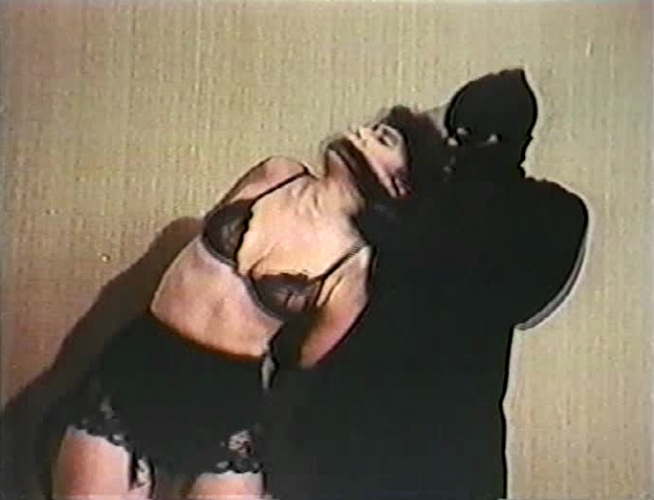
But Delitti is not merely a cheap-looking film – it’s also a distinctly ugly-looking one, with static and grotty camera work complemented by garish wallpaper and hideous 1980s fashions. The abrupt and erratic editing appears to have been done with a chainsaw – frequently cutting from one scene to the next, and then back again, without any rhyme or reason. A particularly jarring example is when the film cuts away from a steamy sex act to the middle of a chase scene, only for it to end shortly afterwards. In fact there is little build-up to most of the murders, and the chases are short and unconvincing. It’s clear that Lenzi has no clue whatsoever as to how to mount any tension and her attempts to add some suspense to the proceedings by slapping on recycled music from Lamberto Bava’s A Blade in the Dark (1983) are all in vain. The only memorable aspect to the stalkings and killings are their sheer tackiness. Slasher films are continuously accused of objectifying women and anyone thinking that a woman in the director’s chair will change that is in for a surprise as Lenzi piles on the sex and nudity just as heavily as her male counterparts. The undisputed highlight is an incredibly sleazy scene where a lingerie-clad Michela Miti is bound and gagged with her own stockings by the black-gloved killer, who then rips off her bra and caresses her naked breasts.


Strip nude for your killer!


Delitti is practically brimming with trashy moments like these, and they provide spectacular amounts of unintentional hilarity. Contributing further to the fun is the illogical and wildly unprictable writing, which results in a series of WTF-moments that truly beggar belief. The most notorious is a scene in which a woman is making a call to the police from a phone booth and gets terrified because a sinister-looking man with a hat, sunglasses and a scarf covering his face comes walking towards her. But all of a sudden the man stops in the middle of the street, takes his coat off and breaks out into an impromptu street dance before vanishing as suddenly as he appeared!!!


The killer? Nope, false alarm! Just a random dancing dude!


Then there’s the matter of the opening sequence when the police are examining the crime scene and we clearly see two dead bodies covered by white sheets on the floor. But throughout the film, the police consistently refer to the crime as one murder – that of Harry Francis. The other corpse (whoever it was) is never mentioned at all!


There are clearly two corpses but apparently only one of them is of any interest to the police!


Another amazing moment comes when Inspector Sanders and his men take some time off from their murder investigation to beat up and arrest a couple of young men for no apparent reason. It’s an entirely irrelevant and randomly thrown in scene that has absolutely nothing to do with the rest of the plot!

And let’s not forget the thoroughly silly striptease scenes performed by the voluptuous sex comedy mainstay Michela Miti (somewhat of a poor man’s Serena Grandi). She strips and struts her stuff like there’s no tomorrow, and she does it so frequently that it soon becomes laughable.


Silly or not, to many viewers these scenes will no doubt be the high point of the film


Other demented moments worthy of special mention include the crazy fight scene between Inspector Sanders and Jimmy the dwarf, and the scene were a woman attempts to calm the nerves of her worried friend by strangling and threatening her – only for them to hug and be chummy seconds later. Finally, there’s a sequence in which the masked killer chases after not one but two characters – only for the scene to cut away without revealing the outcome of the chase. Whether or not the two characters were killed or managed to escape is anyone’s guess because they’re never seen or mentioned again! Incredible! There’s simply no end to all the silliness.

One thing that I rather liked about the film, though, was the presence of an old man nicknamed Chewing Gum, who pretends to be blind so he can more easily eavesdrop on other people’s conversations and blackmail them if he hears incriminating things. This character is no doubt a reference to Pastore’s earlier giallo, the far superior The Crimes of the Black Cat, in which the protagonist is a blind man who overhears a blackmail conversation which proves to be an important clue to the film’s mystery. It’s a nifty reference and a pretty amusing gag.


The fake blind guy


Another connection between the plots of The Crimes of the Black Cat and Delitti is that they both feature a completely far-fetched modus operandi for the killer. In the former, the killer poisons a black cat’s claws with deadly curare and then places it in a basket covered with a shawl doused with cat repellent. When the intended victim removes the shawl to look inside the basket, the cat jumps out and scratches the victim with its poisonous claws – resulting in a deadly heart attack! The murder method used in Delitti isn’t quite as imaginative, and the notion of a killer who carries an extremely poisonous snake on him while he chases and knocks down his victims is completely ridiculous (and the silliness is amplified by the fact that a tiny toy lizard is used for the snake) but Pastore and Lenzi nevertheless score some points for originality. They may have made a terrible film but it is never boring, and that is an admirable achievement!


The none too impressively sized snake takes a bite at one of its victims


Part of the reason why Delitti is never boring is its unpredictability. It is a film full of surprises, and that also applies to the casting – starting with the unexpected appearance of Linda Christian. Yes, the Linda Christian who was a popular Hollywood actress in the 1940s and 50s, and a favored object of the yellow press due to her marriages to Tyrone Power and Edmund Purdom. She was even the very first James Bond Girl, having appeared in a television adaptation of Casino Royale in 1954. Christian eventually settled in Italy, where she starred in a couple of films but retired from acting in the 1960s. In fact, Delitti was her first film in 18 years, and it’s a bizarre comeback role to say the least. She appears only at the start and end of the film as a narrator of sorts – speaking directly to the audience about how the events in the film could just as well happen to us, and cautioning us to choose our friends carefully and make sure none of them are snake lovers!!!


Linda Christian makes a bizarro comeback to the screen


But Linda Christian was not the only well-known actor Pastore and Lenzi were able to coax into appearing in this film. There are in fact numerous familiar faces that make surprise appearances – starting with Giorgio Ardisson, who plays Inspector Sanders’ superior. The athletic and handsome Ardisson had been very popular as a leading man in several Eurospy adventures in the 1960s but his career was in pretty bad shape by the 1980s, and he actually wound up being a regular in Pastore’s films.

Another familiar face from the good old days is German actress Solvi Stubing. A prolific presence in Italian B-movies and fotoromanzi, Stubing was nevertheless best known as the sexy blonde girl in a long series of print and television commercials for Peroni beer, which you can read about here. By the time Delitti was made, Stubing had retired from acting and embarked on a new career as a film journalist – making this another case of a bizarre comeback.

Appearing in the role of the first victim’s sister is Laura Troschel, who is not too well-known to non-Italians but in Italy she was a popular actress in comedies and television dramas, as well as being a singer. Troschel’s career was pretty solid around the time this was made, so her presence is definitely unexpected.

Finally there’s Gianni Dei, who appears briefly as the first victim. Dei, too, is a prolific actor with credits going back to the 1960s but he appeared mainly in trash movies such as Giallo a Venezia (1979) and Patrick Still Lives (1980), so seeing him in this isn’t actually all that surprising.

Overall, though, it is undeniably baffling to find so many old pros appearing in such a terrible film, which couldn’t have looked good even in script form. Most likely it has to do with the fact that prior to becoming a director, Pastore used to work as a journalist and press agent. He presumably made a lot of friends and connections in those days, and was probably able to hire them cheaply later on. Then again, I doubt anyone of the old veterans worked on the film for more than a day or two. They only appear in a few scenes each, and don’t get much to do. The only exception is Ardisson, who actually has a fair supporting role. He even gets involved in a bit of action, even if he does look rather old and tired.


Good old Giorgio Ardisson's still got it!


Also of interest is the casting of the younger actors, who are in large part made up of children of famous actors. Saverio Vallone, who stars as the journalist/mystery writer, is the son of the internationally famous Raf Vallone, and a familiar face to Euro cult fans due to his leading role in the gore classic Antropophagus (1980). There’s also Debora Ergas, daughter of the renowned Sandra Milo, in the role of the nervous and imperiled Susan. This was Ergas’ second and final film role, and that’s no wonder because she’s an absolutely terrible actress who can’t even act scared convincingly. More amusing is Lara Orfei, the daughter of peplum queen Moira Orfei, in her sole film appearance as Inspector Sanders’ teenage daughter who is obsessed with mystery novels. Thrown in for good measure is Austrian actress Sacha Maria Darwin, younger half-sister of the great Romy Schneider, as the inspector’s wife who complains that he’s never at home. Unfortunately, Darwin only appears in a single scene but was later featured more prominently in other trashy escapades such as Lucio Fulci’s Touch of Death and Mario Bianchi’s The Murder Secret (both 1988).


This rare photo printed in the "La Stampa" newspaper in January 1986 shows actors Saverio Vallone and Debora Ergas together with Sergio Pastore


Moira Orfei’s daughter Lara in a small but amusing role as the inspector’s giallo-novel-loving daughter


The spectacularly awful Debora Ergas does her best attempt at looking scared


Many of the female roles in the film are relatively brief – featuring several characters who basically just show up to get killed. The only really substantial female part is that of Julie Garrett, which Giovanna Lenzi made sure to award herself. In her mid 40s at the time, Lenzi is clearly much too old for the role and makes for what is probably the most awkward "final girl" of all time. But – like everything else that fails in this film – it only adds to the unintentional hilarity.


Lenzi as the final girl


I don’t think there is much else to be said about Delitti. It is simply a staggeringly incompetent train wreck of a film that gives a whole new meaning to the term bad. But while it fails miserably as serious entertainment, it is still an absolute riot due to its demented storytelling and all-around ineptness. Delitti is nothing less than a trash masterpiece of epic proportions and must not be missed by aficionados of crazy, demented schlock.


© 2013 Johan Melle


The cast:


Saverio Vallone as Bob Rawling


Giovanna Lenzi as Julie Garrett


Tony Valente (???) as Inspector Sanders


Michela Miti as Betty


Gianfranco Gallo as William Becker


Luigi D'Ecclesia as Jimmy


Debora Ergas as Susan


Alessandra Izzo as Helen


Giorgio Ardisson as The Chief of Police


??? as Rhett


Laura Troschel as Mirta Francis


Remo Capitani as 'Chewing Gum'


Solvi Stubing as Harriet Anderson


Gianni Dei as Harry Francis


Lara Orfei as Lara Sanders


Sacha Maria Darwin as Inspector Sanders’ wife


??? as Herbert


Emy Valentino as Jimmy’s girlfriend


Alessandro Croce as The Medical Examiner


??? as Inspector Sanders’ Assistant


??? as Lara’s Friend


Giovanni Nardoni as Bob’s Colleague


Linda Christian as The Narrator