Viser innlegg med etiketten luigi russo. Vis alle innlegg

tirsdag 7. juli 2015

La morte scende leggera


Italy, 1972

Directed by Leopoldo Savona

Cast:
Stelio Candelli, Patrizia Viotti, Veronika Korosec, Tom Felleghy, Fernando Cerulli, Antonio Anelli, Marcello Di Martire, Rossella Bergamonti, Franco Marletta, Lella Cattaneo


Leopoldo Savona was a bit of an oddball director whose career was made up mostly of low-budget spaghetti westerns, but he also made two attempts to tackle horror and thriller material – first with the stylish and underrated gothic horror film Byleth (1972) and then with the little-known giallo La morte scende leggera (translation: Death Descends Lightly).

The plot deals with shady drug trafficker Giorgio Darica (Stelio Candelli), who returns home from one of his “business trips” and finds his estranged wife Irina with her throat slashed. Fearing he’ll be the police’s number one suspect, Giorgio seeks help from Magrini (Fernando Cerulli), a corrupt magistrate he has dirty dealings with. Magrini and Giorgio’s shady lawyer Savara (Tom Felleghy) arrange for Giorgio to hide out in a temporarily abandoned hotel until they can set him up somewhere more permanently. Giorgio goes along with the plan but insists on bringing his mistress Liz (Patrizia Viotti) along to the hotel – against Savara’s wishes.


Giorgio


Giorgio seeks help from his big shot friends


At first, Giorgio and Liz seem to settle in well and enjoy spending their time relaxing, watching old porn loops on a projector, and having lots of sex, but it doesn’t take long before the confinements of the hotel causes boredom and paranoia to kick in. Liz starts questioning whether Giorgio has actually murdered his wife or not, and the two are soon at each other’s throats and arguing violently.


Sex and games at first...


...then boredom sets in...


...and finally hysteria


Things take a turn for the worse when it turns out that Giorgio and Liz are not alone at the hotel. In the middle of the night, Giorgio is awoken by strange sounds and heads downstairs, where he finds a middle-aged woman murdered – her throat slashed just like Giorgio’s wife. Suddenly, the hotel owner (Antonio Anelli) appears and matter-of-factly explains that the woman is his wife, whom he has just murdered because her jealousy was making his life unbearable. The strange hotel owner tells Giorgio that the two of them are in the same boat now and asks him to help dispose of the body – to which Giorgio reluctantly agrees, but the hotel owner’s bizarre behavior soon has him questioning his own sanity and whether or not what is happening is actually real.
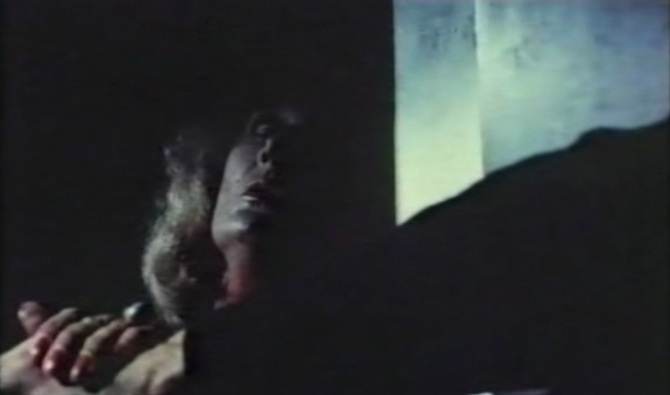


Murder!


Giorgio becomes an unwilling accomplice


Complicating matters further is the sudden arrival of the mysterious Adele (Veronika Korosec), who claims to be the hotel owner’s daughter, and who begins playing mind games with Giorgio and trying to seduce him. The increasingly distressed Giorgio is unable to tell whether Adele is real, or a figment of his imagination, or perhaps even a ghost. Has he gone mad? And is he the killer of his wife or not?


The mysterious Adele


Giorgio and Liz start to get freaked by all the strange going-ons


La morte scende leggera is another one of those little-seen gialli that has lapsed into obscurity and is currently circulating only through rips of an old Italian VHS with English fan subs slapped on top of it. Production of the film was originally announced in Variety back in June 1971 under the slightly longer title La morte scende leggera come un ragno (Death Descends Lightly Like a Spider), with spaghetti western star Robert Wood set to star alongside Patrizia Viotti. By the time it went into production, however, Wood had been replaced with Stelio Candelli. The film was eventually completed and approved by the Italian censorship board in August 1972 but for reasons unknown it did not hit Italian movie screens until two years later – making little impact at the box office and apparently never receiving an English dub. Interestingly, the blurb in Variety cites Aldo Marcovecchio – who had previously written The Night of the Damned (1971), which also starred Viotti, as well as Savona’s previous horror film Byleth (1972) – as the writer whereas the film’s opening titles credit the story to Luigi Russo and the screenplay to Russo and Leopoldo Savona, with no mention of any sort for Marcovecchio. It is still very much possible, however, that Marcovecchio had a hand in the script because the bizarre screenwriting traditions in Italy at the time meant that writers who contributed substantially to a film’s screenplay might end up receiving no credit at all while someone who had comparatively little to do with the finished script might end up receiving full credit for it.

As for the film itself, La morte scende leggera is another case of a rare giallo that has faded into obscurity for a reason. It starts out promisingly enough, with the seemingly abandoned hotel serving as a suitably sinister and claustrophobic setting for the action. But it doesn’t take long before the confinements of the hotel start to bore and frustrate the two main characters, and unfortunately, their boredom quickly rubs off on the viewers as Savona’s direction is languid and lacking in momentum. The ghostly twist is a welcome change of pace from the usual giallo routine, but Savona seems unsure about how to handle it, and the big climatic reveal is clumsily telegraphed early on. Still, the film isn’t necessarily all that bad – the real problem is rather that everything is so hopelessly indistinct. The cinematography by Luciano Trasatti is pretty slick, but for a giallo it is rather on the ordinary side. There’s none of the visual panache we’ve come to expect from these films, and likewise, there are no flashy or stylish murder set-pieces, or even the requisite kitschy fashion tastes – presumably a result of the visibly meager budget. Again, nothing is outright bad, but the execution is consistently half-assed.
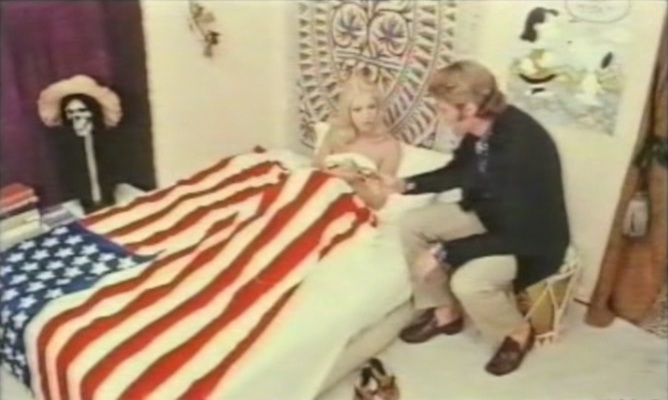

There’s an unfortunate lack of extravagantly silly fashion and décor choices but, thankfully, Liz’s ghastly decorated bedroom is an exception


Thankfully, there are some notable exceptions to the mediocrity which are able to redeem the film somewhat – most notably the soundtrack by Lallo Gori and particularly the cool, guitar-driven song “Sunday in Neon Lights” – performed by Ghanaian prog rock singer Mack Sigis Porter – which plays over the opening titles and which is repeated at various times throughout the film. This song was not written for the film (it is instead taken from Porter’s 1972 album “Peace On You”), nor did composer Gori have nothing to with it, but according to Quarter Records’ CD release of the film’s soundtrack, Gori nevertheless “designed his orchestration to match the song and creates a memorable, haunting tapestry of madness, mod and psychadelia”. Gori’s compositions do indeed match the song very nicely and together they help set a nice atmosphere and mood for the film. You can listen to the song yourself here:


Another priceless highlight is the scene where Giorgio and Liz are in bed watching a sex loop on an 8mm projector that Giorgio has very conveniently brought with him. You can’t go on the run without one of those! Anyway, what’s interesting is that the footage being shown on the projector is actually a recycled sex scene from Savona’s previous horror film Byleth (1972) featuring the beautiful Marzia Damon. This scene even gets a little meta on us when Liz asks if the loop is Italian and Giorgio informs her that Italy is producing more of this stuff than Sweden and Denmark.


Nothing sets the mood like some good 8mm porn


It is also interesting to note how the film foreshadows Umberto Lenzi’s Spasmo (1974) in the way it questions the sanity of its protagonist, although ultimately the film’s troubled release story resulted in the Lenzi film being the first to hit movie screens. The hotel setting and ghostly apparitions means that the film also manages to foreshadow Stanley Kubrick’s iconic The Shining (1980), though only on paper as the two films couldn’t possibly be more different in execution. If anything, the atmosphere of La morte scende leggera, with its zero budget look and confined setting, most of all resembles a Jess Franco film.


Casting for the film is somewhat odd – headlined by spaghetti western bad guy Stelio Candelli in one of his relatively rare starring roles. Candelli’s hard face and intense gaze made him an unusual choice for leading roles and as such he is a nice fit to play a shady crook like Giorgio. He’s not a particularly sympathetic protagonist, but the film deliberately plays on this by keeping the viewers in the dark about whether or not Giorgo has murdered his wife. The opening scene simply shows him exiting his apartment building looking all wild-eyed, sweaty and nervous, but it is unclear whether his agitated state is due to having just committed a murder or simply because he has just found his wife dead and is nervous about becoming a suspect. It’s a nice approach, but it never quite succeeds – largely because Giorgio is not only a rather unsympathetic character, but also a boring one. Candelli is a good actor and does a decent job, but there’s only so much you can do with such a thinly drawn and underdeveloped character.


Guilty? Or just nervous?


Filling the part of the female lead is the dour-eyed Patrizia Viotti, who gives off a rather unlikable vibe throughout the film, although it’s difficult to tell whether this is intentional or not. She is as quick to disrobe here as she was in Filippo Walter Ratti’s sexy-gothic horror film The Night of the Damned (1971) but her acting rarely rises above passable except for a well-done freak-out scene where she gets into a violent confrontation with Candelli.


Patrizia Viotti


The most familiar name in the supporting cast is surely that of Hungarian-born character actor Tom Felleghy, one of the most frequently employed actors at Cinecittà, with appearances in more than 200 Italian productions (be it western, giallo, horror, peplum, crime, comedy, Eurospy etc) but usually in small roles limited to a scene or two. The role of Giorgio’s shady lawyer allows Felleghy to take on a more substantial part than usual for him, and it is nice to see him get a fair bit of screentime even if the role itself is hardly all that exciting.


Tom Felleghy


La morte scende leggera might be worth a watch, I guess, as it has a couple of interesting moments and a terrific soundtrack, but this is definitely a lower-tier giallo, so approach it with low expectations.


© 2015 Johan Melle


The cast:


Stelio Candelli as Giorgio Darica


Patrizia Viotti as Liz


Veronika Korosec as Adele


Tom Felleghy as Attorney Savara


Fernando Cerulli as Magistrate Magrini


Antonio Anelli as Hotel owner


Marcello Di Martire as Commissioner De Carmine


Rossella Bergamonti as Marisa


Franco Marletta as Malvestiti, the film director


Lella Cattaneo as Hotel owner’s wife


søndag 20. mars 2011

Lost film #4: Paura


Italy, 1972

Directed by Luigi Russo

Cast:
Rosario Borelli, Kai Fischer, Rosalba Grottesi, Patrizia Gori


Unfinished, unreleased or lost films have always intrigued me, and it is really interesting to try and piece together information about such projects. One lost film that is particularly fascinating is the thriller Paura (or Fear as it translates to in English), which was written and directed by little-known filmmaker Luigi Russo, who spent most of his career making various skin flicks such as the Blue Lagoon rip-off Blue Island (1982) with Sabrina Siani. Paura was Russo's directorial debut and it has never been released. Apparently, shooting was nearly completed but the was shut down when Russo ran out of money.

Due to its unavailability there is little information available on Paura but, fortunately, great Italian magazine Cinesex ran a piece on the film in early 1972. The article includes both pictures and a plot summary that helps give you an idea about what the film is like.

According to the plot summary in the Cinesex article, Paura opens in brutal fashion: a beautiful girl named Orsola is violently raped by three masked men. Orsola becomes pregnant after the rape and eventually gives birth to a deformed and grotesque son - a "monster". But in spite of his physical appearance and the circumstances under which he was conceived, Orsola loves her son and she wants to protect him from the gazing eyes of people who do not accept anything that is different. Hence, she takes her baby son and hides with him in the abandoned underground level of an old theater.

Cut to 20 years later. The "monster" is now grown up - having spent his entire life in the theater's abandoned underground level and never having seen other people than his mother. One day, however, an acting troupe consisting of four men and four women arrive at the theater to rehearse a play. Apparently, several of the actors are quite horny, and in between rehearsals they sneak off to look for isolated spots to have sex. Naturally, they end up in the theater's underground area and start to go at it without knowing that they are being watched by the "monster". Having never been exposed to sex before, the "monster" snaps after witnessing all the copulating, and starts killing the unsuspecting theater actors one by one.


From the plot description, Paura appears to be more of a horror movie than a giallo, and it sounds fairly bizarre. According to the Cinesex article, the killer only murders the men, whom he considers as sexual rivals (although he does kill one unfortunate woman too because her short hair made him think that she was a man!) and this is a rather unusual touch. The women figure prominently in the many sex scenes, though, and the Cinesex article includes several stills from a lesbian scene between the sexy platinum blonde Patrizia Gori and another unidentified actress. Below are some scans of this lesbian love scene:


The Cinesex article briefly mentions that Paura stars Richard Melvill, Kai Fischer, Rosalba Grottesi and Patrizia Gori, but it doesn't say anything about the roles they play. Let's take a little closer look at these four actors, though.


First off, Richard Melvill is actually a pseudonym that was used by Italian actor Rosario Borelli in a couple of early 1970s films.

Rosario Borelli as he looked in The Cynic, the Rat & the Fist (1977)

Borelli had been a popular leading man in the 1950s but when he got older he switched to directing and acting in violent photo-novels such as "Antar" and "Killing", and playing supporting roles in Euro-crime movies. At the time Paura was filmed, Borelli was in his mid 40s, so clearly it cannot be him who plays the monster (who is supposed to be 20). Presumably, he plays one of the actors - or maybe the director. No director is specifically mentioned in the plot summary but it seems likely that such a character could be present and it would fit Borelli age-wise.


Then we have Kai Fischer, a popular German actress known for numerous krimis such as Room 13 and The Monster of London City (both 1964), and Mel Welles' cult horror movie Man Eater of Hydra (1967).

Kai Fischer in a still from Room 13

Fischer was pushing 40 when Paura was made, so it seems like a fair guess that she plays the role of Orsola, the mother of the "monster".


Beautiful and likeable blonde starlet Patrizia Gori plays one of the horny young theater actresses, and she figures prominently in the pictures of the lesbian scene printed in Cinesex.

Patrizia Gori photographed by the famous Angelo Frontoni in 1973

Gori was just getting her career started when she appeared in Paura, and she seemed to be suffering from bad luck. Not only was Paura never released but her next film, the obscure giallo Crazy Desires of a Murderer (1973), was also shelved for several years. She soon found success, though, in sleaze classics such as Emanuelle and Françoise (1975), Cries and Shadows (1975) and Elsa Fräulein SS (1977), and was married for several years to porno director Franco Lo Cascio (a.k.a. Luca Damiano).


Also listed as a cast member is the gorgeous, raven-haired Rosalba Grottesi. Although she only appeared in a handful of films, Grottesi had enormous success as both leading ladies and femme fatales in photo-novels during the 1960s and 70s, and she would continue to play supporting parts in photo-novels up until her retirement in 2001.

Rosalba Grottesi in a photo-novel from 1973

Again, there is no mention about what kind of character she plays in the film but I think it is reasonable to assume that she plays one of the theater actresses.


This is pretty much all the information I've been able to dig up about Paura. As I've already mentioned, the shooting the film was apparently close to being finished and the footage is supposed to still exist. It has, however, never been edited or dubbed and, quite frankly, I find it highly unlikely that it ever will be after so many years. And that's a great shame because Paura sounds just like the kind of film I'd like to watch. It has some really cool actors, the plot sounds delightfully bizarre, and I imagine that the theater setting could be used to very atmospheric effect as it was in later films like The Killer Reserved Nine Seats (1974) and Stagefright (1987).

tirsdag 23. februar 2010

Dangerous Women/Le diaboliche


Italy, 1989

Directed by Luigi Russo

Cast:
Lisbeth Hummel, Pierangelo Pozzato, Beatrice Palme, Giulia Urso


After recently watching and enjoying Formula for a Murder (1985), Alberto De Martino’s nice little thriller about an evil plot to scare a wealthy wheelchair-bound woman to death, I kept feeling an irresistible urge to also check out Luigi Russo’s Dangerous Women since it has a pretty similar plot. But as it turns out, the two films are rather dissimilar in execution.

The plot centers around Elise Manning (Lisbeth Hummel), a wealthy heiress who is confined to a wheelchair. Although good-natured, Elise seems to be a rather lonely woman with few friends, and she lives by herself in a large mansion with only her housekeeper, Vivian (Beatrice Palme), and the chauffeur-cum-gardener, Angelo (Pierangelo Pozzato), to keep her company. The lonely Elise is so appreciative of Vivian’s hard work and companionship that she has decided to make her the sole beneficiary of her will. But poor Elise also suffers from a weak heart. So weak in fact that a friendly nurse named Giulia (Giulia Urso) comes by every day to check up on her. The doctor has said that any strong emotion could be fatal for her, so Elise needs to be quite careful! Hmm... care to take a guess where this is going?
Well, as you might have anticipated, Vivian has no intention of slaving around in a maid’s uniform for decades while she waits for Elise to croak. Instead she and Angelo (who is her lover) hatch a diabolical plot to frighten Elise to death – thus making her death appear natural.


Elise

The hellish housekeeper - one of the dangerous women alluded to in the title


Setting her evil plan in motion, Vivian tells Elise that she has to go away for some days because her sister has been hospitalized. Elise says she’ll manage on her own for a few days but shortly after Vivian’s departure bad things start happening. Her wheelchair mysteriously vanishes, and with no one else in the villa, she has little choice but to get down on the floor and crawl around the house in search of her missing wheelchair but to no avail. Elise quickly senses that she isn’t alone. Someone seems to be hiding in the mansion – someone who means her harm. But Elise comes to realize that whoever is lurking around in the villa doesn’t seem to be out to kill her but rather to terrorize and torment her. Alone, defenseless and heartsick, Elise is nevertheless determined to get the better of her tormentor but will her weak heart be able to sustain the ordeal?


Elise fights to stay alive


Director Luigi Russo is a fairly obscure figure in the world of Italian B movie cinema. He started out writing the screenplays of a few decamerotic films in the early 1970s, before moving on to write and direct his own films. The majority of Russo’s directorial output consists of little-known erotica efforts such as The Black Maid (1976) with Ines Pellegrini, and Blue Island (1982), a Blue Lagoon rip-off starring Sabrina Siani.

It is worth taking note of the fact that Russo didn’t merely write and direct his own movies – he frequently did editing and cinematography duties on them as well. To be honest, I suspect that his motives for doing so have less to do with him being a true auteur and more to with the fact that it’s cheaper to make a film when you’re doing everything by yourself. Nevertheless, this does mean that Russo was pretty deeply involved in most of the films he made, and this is also the case with Dangerous Women, which he wrote, directed, photographed, edited and even produced through his own company, Luigi Russo Produzione. It was the first film he had directed in almost seven years and it is a clear departure from the sex romps he used to specialize in. Russo’s only prior experiences with the thriller format is limited to co-writing the dismal giallo La morte scende leggera (1972) and directing the unreleased thriller Paura (1972), which starred German actress Kai Fischer and a young Patrizia Gori at the start of her career. But in spite of his somewhat limited experience with the genre, Dangerous Women is proof that Russo is still able to craft a reasonably engaging thriller that manages to hold ones attention.

Though sometimes referred to as a giallo, Dangerous Women can’t really be classified as such, although it admittedly has a few similarities to the twistful inheritance-plot gialli of the 1960s. But more than anything the plot is a reworking of the classic Les Diaboliques (1955) – a fact which is clearly acknowledged in the film’s original Italian title, Le diaboliche – with a couple of new twists and ideas thrown into the mix. The most notable difference is of course the fact that the imperiled leading lady is wheelchair-bound – a plot point that has been snatched from Formula for a Murder, which, of course, is a Les Diaboliques rip-off itself, although a highly enjoyable one.

Just to be clear, though: Dangerous Women is nowhere near as good as Formula but it has more going for it than you might expect from a late 1980s Italian thriller. The pacing is surprisingly snappy as Russo wastes very little time with setting up the plot before jumping right onto the terrorization of Elise. Russo uses the large villa setting to good effect and manages to create some nice tension as neither the paralyzed heroine nor the audience is exactly sure about who’s hiding there. And the scenes where the frightened Elise crawls around in the large mansion while clutching to a kitchen knife do a good job of establishing Elise as both vulnerable and highly exposed to her tormentor.


Terror in the dark


Seeing as there are only four characters in the entire film, it goes without saying that there are few kills, and the few deaths that we do get are not gory since Russo is clearly favoring psychological terror over splattery mayhem. There is, however, a surprisingly brutal scene where the mysterious tormentor violently attacks Elise with her own wheelchair. Filmed from the attacker’s POV as he repeatedly smashes the wheelchair into the poor defenseless woman, this relentless and prolonged sequence has a mean-spirited streak to it and is actually very unpleasant to watch.


Nasty wheelchair violence


On the technical side, Russo’s cinematography is fairly slick, and Luigi Ceccarelli provides an excellent synthesizer score that underlines the suspense perfectly. But the one really serious complaint I have about Dangerous Women (outside of a completely asinine surprise twist at the end) is that the concept is stretched out too far. At 90 minutes, the film is overlong. It would probably have worked better as a one-hour installment in an anthology series à la the popular 1970s TV series Thriller but there isn’t quite enough plot to fill an hour and a half, and consequently we get a bit too many long stretches with Hummel crawling around on the floor to the strains of Ceccarelli’s agreeable synthesizer score.


Crawling aplenty


The film is further hampered by a horrendous English dubbing job that is so flat and un-emotive that it seriously undermines the performances of all the actors. Thankfully, there’s only a limited amount of dialogue, which makes it more bearable but it’d still be nice to be able to watch this one in Italian with subtitles as I’m certain it would benefit from it.

Character motivation is at times a little shaky too. Because Elise has little interaction with other characters, we get rather limited access to what goes on inside her head, and this begins to pose somewhat of a problem once Elise starts making improbable choices. It seems highly illogical that when the nurse who checks up on her every day stops by, Elise pretends that everything is like normal because she’s too proud to ask for help. This sort of bizarre character motivation is hard to swallow but as the film progresses, we gradually begin to accept Elise’s determination and stubbornness as she lets her tormentors’ plot unfold while she starts preparing a trap of her own. In this regard, the Elise character is quite similar to the heroine of José Maria Forqué’s underrated giallo In the Eye of the Hurricane (1971), who also seemingly sits passive and lets a plot to murder her play out.

The casting of the film is quite interesting. The wheelchair-bound heroine is played by Danish actress Lisbeth Hummel, who is the real-life wife of Luigi Russo. In the 1970s, she appeared in several film directed by her husband but her most famous part was unquestionably her leading role in Walerian Borowczyk’s notorious arthouse shocker The Beast (1975). Hummel retired from films at the end of the 1970s but after a 10 year break from the limelight her husband convinced her to return before the camera to play the leading role in Dangerous Women. At the time she was pushing 40, and though she was still pretty, Hummel certainly looks far more ordinary and unglamorous here than in her glory days. This works to the film’s advantage, though, as Hummel convincingly looks the part of the lonely and vulnerable wheelchair-bound heiress. Since she spends much of the film in isolation and doesn’t have a great deal of dialogue, she is instead required to rely on her body language and facial expressions to convey the character’s emotions. On top of that, the role is very physically challenging as Hummel has to spend much of her screen time crawling the floors of the massive villa. I must say she manages this task really well, and her performance is what really holds the film together.


Hummel gets ample opportunity to play on fear and terror


It’s difficult to fully assess the performances of the three remaining actors because they are all badly dubbed and not given that much to do. Pierangelo Pozzato and Beatrice Palme act appropriately slimy as the greedy servant couple but neither of them are able to transcend the clichéd nature of their characters. Pozzato has just the right face for this type of unsympathetic role, though, and aficionados of extreme Euro-sleaze will probably remember him fondly for his role as one of the escaped death row prisoners terrorizing a women’s penitentiary in the unforgettable W.I.P. trash masterpiece Blade Violent (1983). Palme, while far less prolific in genre cinema, has enjoyed a long and successful career – appearing in everything from the obscure Fred Williamson action film Foxtrap (1986) to the internationally revered Cinema Paradiso (1988).
My favorite in the supporting cast, though, is the sexy Giulia Urso, who plays the growingly suspicious nurse who comes to check on Elise. Unfortunately, she never managed to make much of a career for herself. Outside of a supporting role in Sergio Martino’s WW2 action flick Casablanca Express (1989), she only appeared in a handful of pretty non-noteworthy films.


Pozzato and Palme as the bad guys

In sum, Dangerous Women is a pretty nice entry in the extremely short-lived fad of Italian wheelchair-terror flicks (actually, outside of this and Formula for a Murder there doesn’t really seem to be any other examples of this sub-genre, although a wheelchair does feature prominently in Leandro Lucchetti’s oh so subtly titled Bloody Psycho (1989), which I’ll probably cover later on). Anyway... as long as you’re able to overlook the incredibly stupid ending, the rest of the film is – in spite of its flaws – a fairly enjoyable way to spend an hour and a half, so I say give it a shot if you liked Formula for a Murder.


© 2010 Johan Melle


The cast:

Lisbeth Hummel as Elise Manning


Beatrice Palme as Vivian


Pierangelo Pozzato as Angelo


Giulia Urso as Giulia